


The Growing Junkyard Above Us
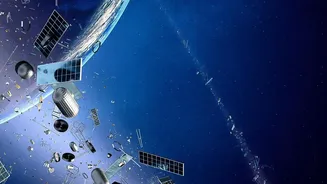
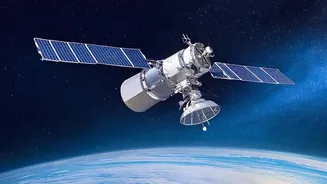
For decades, every rocket launch and satellite deployment has left something behind. Today, hundreds of thousands of pieces of orbital debris, from defunct satellites to tiny flecks of paint, are zipping around Earth at speeds up to 28,000 km/h. This
creates a hazardous environment for the thousands of active satellites that power our global communications, navigation, and scientific research. The primary fear is a cascading chain reaction known as the Kessler Syndrome, a theory proposed in 1978 by NASA scientist Donald J. Kessler. This scenario suggests that if the density of objects in low Earth orbit (LEO) becomes too high, collisions will create more debris, which in turn increases the likelihood of more collisions, potentially rendering entire orbits unusable for generations.
The Challenge of Taking Out the Trash
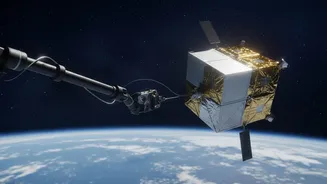
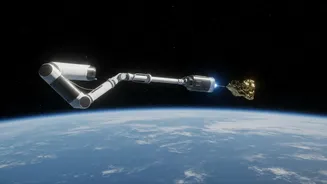
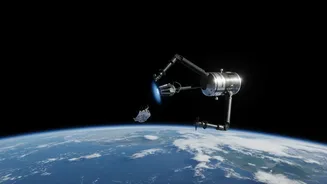
Removing space debris, a process known as Active Debris Removal (ADR), is incredibly complex. Previous and existing concepts have significant drawbacks. Methods like nets and harpoons require direct contact with a piece of debris, which is often tumbling uncontrollably. Such contact risks damaging the capture vehicle or, even worse, creating even more fragments. Other concepts like robotic arms face similar challenges with high costs and the immense difficulty of grappling a fast-moving, non-cooperative target. Furthermore, legal and political issues of ownership complicate matters, as one country cannot simply remove another's defunct satellite without permission. These technical and regulatory hurdles have made cleaning up space a slow and challenging endeavor.
A Magnetic Solution Emerges
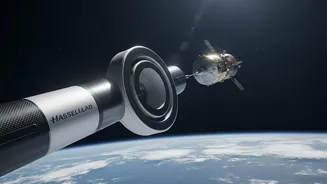
This is where magnetic capture offers a significant advantage: it's a contactless approach. The concept involves a 'chaser' satellite equipped with a powerful electromagnet approaching a piece of debris. By generating a strong magnetic field, the chaser can influence the target without physically touching it. This force can be used to attract or repel the debris, gently nudging it to stabilize its tumble or begin its journey toward a lower orbit where it will burn up in the atmosphere. This method is particularly promising because many satellites already contain magnetic components, such as magnetorquers used for attitude control, making them susceptible to magnetic influence without needing any special pre-installed hardware. For future satellites, the addition of a simple ferromagnetic docking plate could make them easily retrievable.
Putting Magnetic Tethers to the Test
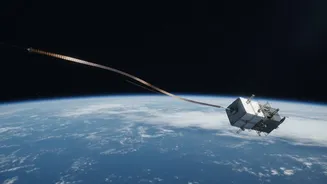
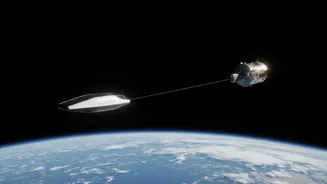
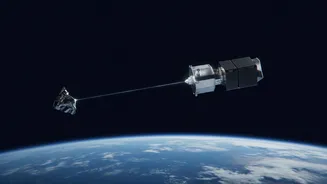
Recent tests have demonstrated the viability of this technology. One approach, known as an electrodynamic tether, involves deploying a long, conductive wire that interacts with the Earth's magnetic field to create a Lorentz force. This force acts as a drag, slowing the satellite down and causing its orbit to decay much faster than it would naturally—all without requiring propellant. Projects like the European E.T.PACK-F are preparing for in-orbit demonstrations to validate these propellant-less systems. Other tests, like the ELSA-d mission from the company Astroscale, have successfully used a magnetic system to capture and release a simulated piece of debris in orbit, proving the core mechanics of the grappling technology work in space. These tests show that magnetic systems can safely interact with and control target objects from a distance, a crucial step in making debris removal safer and more reliable.
The Future of a Cleaner Orbit
The success of these advanced magnetic and electrodynamic tether tests marks a pivotal moment for sustainable space operations. By providing a safer, more controllable, and potentially reusable method for capturing debris, this technology helps overcome major obstacles that have hindered ADR efforts. A contactless system reduces the risk of creating more debris during capture, one of the biggest ironies and dangers of the cleanup process. As we continue to launch mega-constellations of satellites, the need for a viable orbital cleanup solution is more urgent than ever. Magnetic capture systems, combined with a growing international focus on space sustainability, offer a clear path toward managing our orbital environment and ensuring that space remains a usable resource for science, commerce, and exploration in the future.