

A New Shape in the Clouds
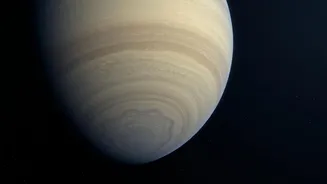
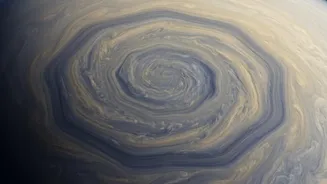
For decades, scientists have been captivated by a giant, six-sided jet stream at Saturn's north pole, known as the hexagon. It's a remarkably stable storm, wider than two Earths, that has raged for over 40 years. Now, Hubble has revealed a southern counterpart:
a massive, 10-sided wave, or decagon, encircling the planet's south pole. This is the first time such a large, regular-sided jet pattern has been seen in Saturn's southern hemisphere, challenging the idea that the northern hexagon was a complete anomaly. The discovery, published in the journal Science Advances, suggests the gas giant’s atmospheric dynamics are even more complex than previously understood.
An Evolving Mystery
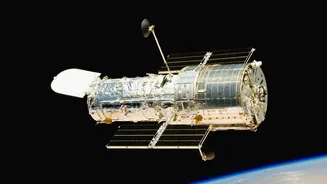
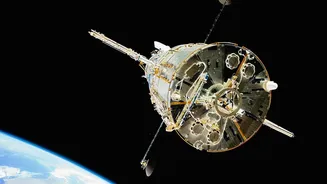
Unlike the long-standing northern hexagon, this southern decagon appears to be a recent development. By analysing years of data from Hubble's Outer Planet Atmospheres Legacy (OPAL) program, which takes yearly portraits of the outer planets, researchers found faint hints of the structure emerging as early as 2023. It only became a clearly defined pattern in more recent observations. The discovery was made possible as Saturn's long seasons, each lasting about seven Earth years, tilted the south pole back into view from Earth after it was hidden from sight for years. This gives scientists a rare opportunity to watch a giant atmospheric pattern develop in real time.
How Is It Different?
While similar in concept to its northern cousin, the southern decagon has its own distinct characteristics. It appears to be more unstable and is not stationary like the hexagon. Instead, it seems to be a meandering atmospheric wave, embedded within one of the planet's powerful jet streams. This structure also extends deep into the atmosphere, meaning it is not just a surface-level cloud pattern. Observations at different wavelengths show the feature at different altitudes, allowing scientists to effectively 'slice' through Saturn's atmospheric layers to understand its three-dimensional nature. The key question puzzling scientists is why it formed so suddenly, when decades of previous observations, including those from the Cassini spacecraft, showed no trace of it.
The Power of a Long Gaze
This discovery highlights the critical importance of long-term observation programs like OPAL. Having a consistent, year-over-year record of a planet's atmosphere allows astronomers to move beyond single snapshots and track gradual, long-term changes like storm formation and seasonal shifts. It was this archive of data that allowed scientists to trace the decagon's formation back in time. By combining Hubble's sharp, visible-light imagery with data from other observatories like the James Webb Space Telescope, which sees in infrared, a more complete picture of Saturn's weather systems is emerging. These ongoing observations will be crucial for determining if the decagon will stabilize into a long-lasting feature like the hexagon or if it will eventually dissipate.