





Beyond the Six-Pack: Understanding True Core Strength
Many people mistake core training for an endless series of crunches aimed at achieving a 'six-pack'. While those surface muscles (the rectus abdominis) are part of the core, true strength lies much deeper. Your core is a complex group of muscles that
wraps around your torso like a natural corset, including your deep abdominals, obliques, lower back muscles, and even your pelvic floor. This muscular network is your body's centre of gravity and powerhouse, involved in nearly every move you make. Functional core training focuses on strengthening this entire system to improve stability, balance, and posture, which in turn reduces the risk of injury and makes daily activities like lifting and bending safer and easier.
The Plank: Your Foundation for Stability
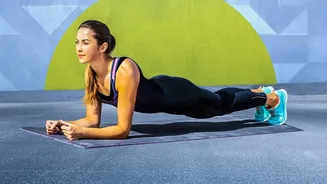
The plank is a fundamental isometric exercise that builds endurance in your entire core. It’s a powerhouse for strengthening the transverse abdominis, the deepest abdominal muscle that stabilises your spine. How to do it: Lie face down and prop your body up on your forearms and toes, keeping your elbows directly under your shoulders. Your body should form a straight line from your head to your heels. Avoid letting your hips sag or rise too high. Engage your abdominals by pulling your navel towards your spine and squeeze your glutes. Hold for 30 seconds, building up your time as you get stronger. Focus on form over duration.
The Bird-Dog: For Balance and a Strong Back
This exercise is excellent for improving stability and training your core muscles to work together while protecting your lower back. It challenges your balance and coordination. How to do it: Start on all fours, with your hands directly under your shoulders and your knees under your hips. Keep your back flat and your core engaged. Slowly extend your right arm straight forward and your left leg straight back simultaneously. Pause for a moment, ensuring your hips and shoulders remain square to the floor without twisting. Return to the starting position with control and repeat on the other side, extending your left arm and right leg. This completes one rep.
The Dead Bug: Activate Your Deep Core
The Dead Bug is a fantastic exercise for targeting the deep core stabilising muscles, including the transverse abdominis, without putting strain on your back. How to do it: Lie on your back with your arms extended toward the ceiling and your knees bent at a 90-degree angle over your hips (tabletop position). Slowly lower your right arm and left leg toward the floor simultaneously. Go as low as you can without letting your lower back arch off the floor. Exhale as you lower, and inhale as you return to the starting position with control. Repeat with the opposite arm and leg.
Bicycle Crunches: Target Your Obliques
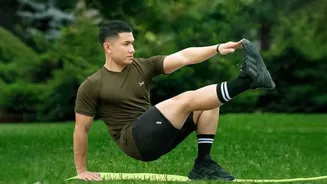
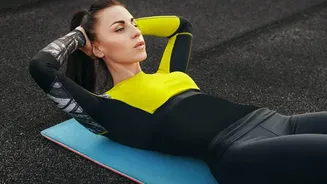
To build a well-rounded core, you need to work your obliques, the muscles on the sides of your abdomen. Bicycle crunches are a dynamic movement that does just that, while also engaging the rectus abdominis. How to do it: Lie on your back with your hands gently supporting your head and your knees bent. Lift your shoulders off the floor and bring your right elbow toward your left knee, simultaneously straightening your right leg. Move in a controlled 'pedalling' motion, alternating sides. Avoid pulling on your neck; the work should come from your abs.
Leg Raises: Focus on the Lower Abs
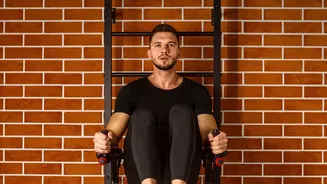
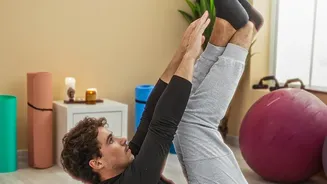
While you can't truly isolate the 'lower' abs, leg raises are highly effective at placing more emphasis on the lower portion of the rectus abdominis. How to do it: Lie on your back with your legs straight and together. You can place your hands under your lower back for support if needed. Slowly lift your legs toward the ceiling until they are perpendicular to the floor. Keep your legs as straight as possible. Pause at the top, then slowly lower them back down without letting them touch the floor before starting the next rep. The key is slow, controlled movement to avoid using momentum.
Putting It All Together: A Simple Routine
Consistency is more important than intensity when you're starting out. Aim to perform a core workout three to four times a week. A great starting point is to choose three to four exercises from this list. Perform each exercise for 10-15 repetitions (or 30-second holds for planks). Complete two to three sets of your chosen exercises, resting for 30-60 seconds between sets. As you get stronger, you can increase the reps, sets, or hold times to continue challenging yourself.