
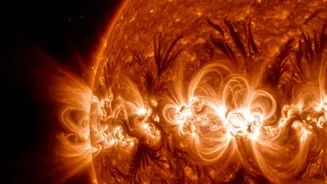
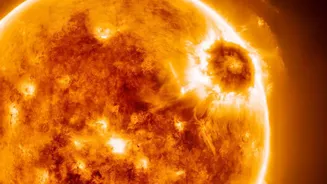
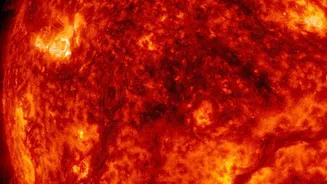
To truly understand our Sun, scientists are learning that two pairs of eyes are better than one. A groundbreaking collaborative study involving India's Aditya-L1 and Europe's Proba-3 missions is proving the immense value of teamwork in space.
India’s Sentinel at L1
India's first
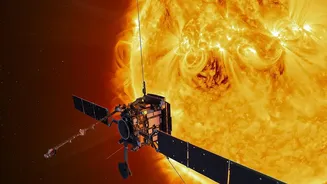
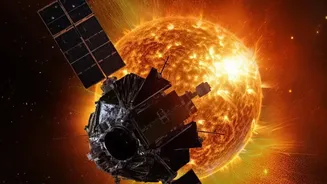
dedicated solar mission, Aditya-L1, holds a unique position in space. Launched by ISRO in September 2023, it orbits the Sun-Earth Lagrange point 1 (L1), about 1.5 million kilometres from Earth. From this vantage point, it can continuously view the Sun without any interruption from eclipses or occultations. Its primary payload, the Visible Emission Line Coronagraph (VELC), is designed to study the Sun’s outer atmosphere, the corona. The mission's broader goals include understanding coronal heating, solar wind acceleration, and the powerful eruptions known as Coronal Mass Ejections (CMEs) that can trigger space weather events affecting Earth.
Europe’s Artificial Eclipse in the Sky
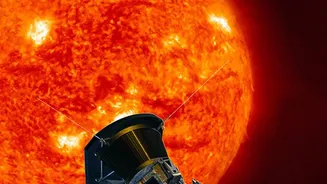
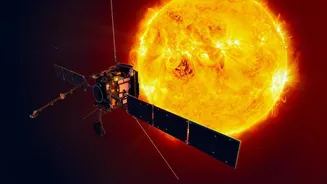
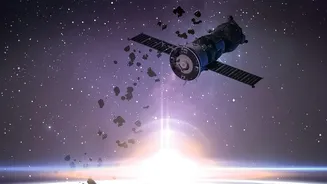
The European Space Agency's (ESA) Proba-3 mission, interestingly launched by an ISRO PSLV rocket in December 2024, is an engineering marvel. It consists of two satellites flying in precise formation, approximately 150 metres apart. One spacecraft, the 'Occulter', blocks the bright disc of the Sun, casting a perfect shadow over the second spacecraft, the 'Coronagraph'. This creates a sustained, artificial solar eclipse, allowing its ASPIICS instrument to capture incredibly detailed images of the Sun's faint, superheated corona, a region notoriously difficult to observe. This precision formation-flying is a world-first, opening a new window into the area where solar wind and CMEs are born.
The Challenge of Studying Solar Eruptions
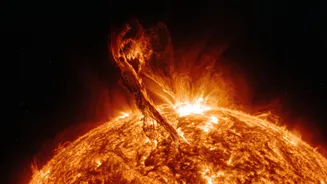
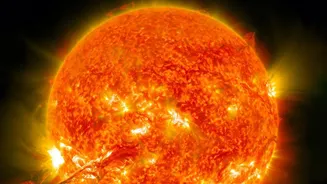
Coronal Mass Ejections are among the most violent events in our solar system. These are massive explosions of plasma and magnetic fields from the Sun's corona that can travel at immense speeds. When aimed at Earth, they can disrupt satellites, power grids, and communication networks. For decades, scientists have struggled to observe the very beginning of these eruptions close to the Sun's surface. The Sun's overwhelming brightness washes out the much fainter corona, and previous instruments couldn't fully track the early evolution of these events, leaving gaps in our understanding of their energy and structure.
A Powerful Combination of Views
This is where the synergy between Aditya_L1 and Proba_3 becomes revolutionary. While Proba_3 uses its artificial eclipse for high_resolution imaging of the corona, Aditya_L1’s VELC instrument performs spectroscopy, which analyses the light to determine properties like the temperature and density of the coronal gas. A recent study published in the journal 'Astronomy & Astrophysics' highlights this collaboration. Scientists from the Indian Institute of Astrophysics and international partners combined data from both missions to analyse two CMEs that occurred in September 2025. This marked the first time observations from both spacecraft were jointly analysed, providing a more complete picture than either mission could achieve alone.
What This Teamwork Unlocks
By combining Proba_3's crisp images with Aditya_L1's spectroscopic data, scientists could cross_check their findings and build a much more accurate profile of the CMEs. They were able to measure the mass, density, and energy of the eruptions with greater confidence. The joint study demonstrated that this dual_observation method provides crucial new constraints on how CMEs evolve in their infancy. One key finding was that the eruptions do not expand uniformly but take on irregular shapes, a detail that was difficult to confirm previously. This deeper understanding is a vital step toward improving our models for predicting space weather and its potential impact on our planet's technological infrastructure.