
Understanding the Threat: Solar Eruptions
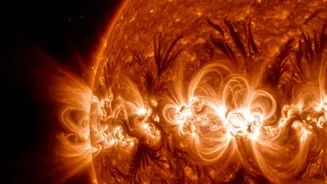
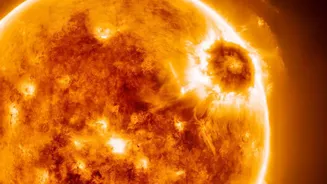
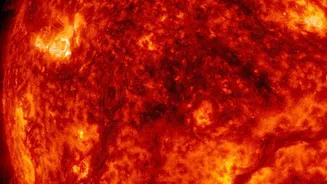
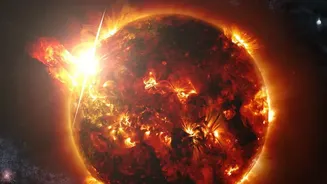
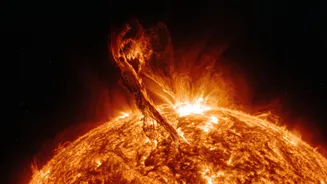
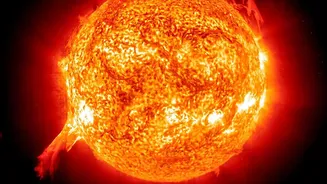
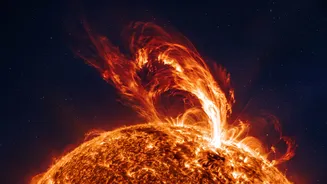
Our Sun may appear as a calm, steady source of light, but its outer atmosphere, the corona, is a turbulent theatre of immense explosions. These events, known as Coronal Mass Ejections (CMEs), are colossal bursts of magnetised plasma and charged particles
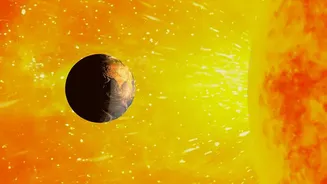
hurled into space at incredible speeds. While many CMEs miss our planet, those directed towards Earth can have serious consequences. They are the primary drivers of 'space weather'—disturbances that can trigger intense geomagnetic storms, damage crucial satellites, disrupt GPS navigation and communication networks, and even endanger astronauts. To protect our technologically dependent society, we must understand how these solar storms form and behave. The biggest challenge has been observing them in their infancy, very close to the Sun's fiery surface, an observational blind spot that this new collaboration is designed to eliminate.
India's Eye on the Sun: Aditya-L1
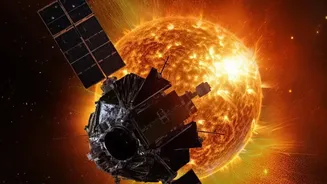
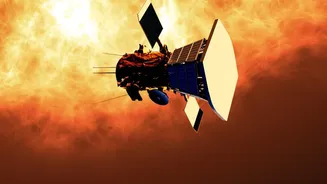
India's Aditya-L1, launched by ISRO, is the nation's first dedicated observatory for studying the Sun. Positioned at the first Lagrange point (L1), about 1.5 million kilometres from Earth, it has an uninterrupted view of our star. Among its suite of seven advanced instruments, the Visible Emission Line Coronagraph (VELC) plays a crucial role. Developed by the Indian Institute of Astrophysics, VELC is designed to study the solar corona closer to the Sun's limb than ever before. It uses spectroscopy to analyse the properties of the coronal plasma, such as its temperature, density, and velocity. This provides crucial information about the hot gas and the conditions that lead to the birth of a CME.
Europe's Artificial Eclipse: Proba-3
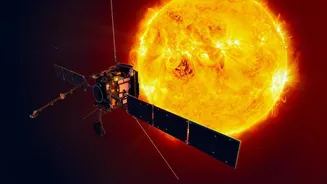
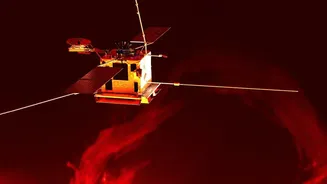
The European Space Agency's (ESA) Proba-3 mission is a technological marvel and the world's first precision formation-flying mission. It consists of two separate satellites flying in perfect tandem, approximately 150 metres apart. One spacecraft, the 'Occulter', positions itself to block the direct light from the Sun's main body. This casts a precise shadow onto the second spacecraft, the 'Coronagraph'. The result is a man-made, total solar eclipse that can be maintained for hours at a time, far longer than any natural eclipse seen from Earth. This ingenious setup allows its ASPIICS coronagraph to capture incredibly clear images of the Sun's faint corona, providing sharp details about a CME's shape, structure, and mass as it erupts.
Stronger Together: A Dual Perspective
The true power of this collaboration lies in combining the complementary capabilities of both missions. While Proba-3 provides crisp, wide_angle images of an erupting CME, Aditya_L1's VELC offers detailed spectroscopic data on the temperature and density of the same event. Scientists can now cross_validate their findings using two different methods, providing a much more complete and reliable picture of a solar storm's genesis. Recent joint observations of two CMEs have already demonstrated the value of this approach. In both cases, VELC detected the eruptions in their earliest stages, while ASPIICS tracked their structure as they expanded. This dual_view allows scientists to accurately measure a CME's mass, density, and energy, constraining the physics of how these events are powered and evolve right from the source.