


The Software and AI Revolution
The modern space race is built on code. From autonomous rovers navigating Mars to satellite constellations managing Earth observation data, software is the backbone of nearly every mission. Agencies like ISRO and a growing number of private startups such
as Skyroot Aerospace, Agnikul Cosmos, and Pixxel are actively hiring computer science engineers. Skills in artificial intelligence and machine learning are particularly valuable. AI is used to process vast amounts of data from telescopes, automate satellite operations, predict cosmic events, and even help design and simulate spacecraft before they are built. Proficiency in programming languages like Python and experience with AI frameworks like TensorFlow and PyTorch can open doors to roles in mission control software development, autonomous systems, and data analysis.
The Age of Big Data from Space
Every satellite, probe, and telescope generates enormous volumes of data, with NASA's archives already holding over 100 petabytes. This explosion of information has created a huge demand for data scientists and analysts. These professionals are needed to sift through satellite imagery, analyse climate patterns, monitor agricultural health, and track orbital debris. The ability to manage and interpret big data is critical for turning raw information into actionable insights for everything from weather forecasting to national security. As India's space economy is projected to reach $44 billion by 2033, the demand for experts who can make sense of this cosmic data deluge is only set to increase.
Robotics and Autonomous Systems
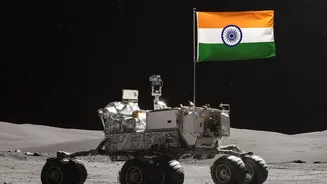
From robotic arms on the International Space Station to rovers exploring distant planets, robotics is fundamental to modern space exploration. This field requires a blend of mechanical engineering, electronics, and computer science. Engineers specialising in robotics and automation design the systems that can perform tasks too dangerous or delicate for humans. In India, the focus on advanced manufacturing and complex missions is driving the need for experts in Guidance, Navigation, and Control (GNC), which are the brains behind any autonomous vehicle or spacecraft. A background in mechatronics or robotics can lead to a career designing the next generation of space exploration hardware.
Electronics and Communication Engineering
Spacecraft are complex electronic systems that must operate flawlessly in the harsh environment of space. Electronics and communication engineers are vital for designing the communication payloads, navigation systems, control systems, and sensors that allow satellites and probes to function and transmit data back to Earth. ISRO consistently recruits for these roles, which are essential for the success of communication, navigation, and remote sensing missions. As private companies like Dhruva Space and Bellatrix Aerospace develop their own satellite and propulsion technologies, the need for skilled electronics engineers in India's private space sector continues to grow.
Advanced Manufacturing and Materials Science
Building rockets and satellites that can withstand extreme temperatures and forces requires innovation in materials and manufacturing processes. Former ISRO Chairman S. Somanath has highlighted the need for scaling advanced manufacturing in India to meet global demand. This creates opportunities for materials scientists and mechanical engineers with expertise in areas like 3D printing (additive manufacturing), composites, and novel alloys. These skills are crucial for creating lighter, stronger, and more cost-effective components for launch vehicles and spacecraft. As the industry moves towards mass manufacturing of satellites and rockets, professionals who understand the intersection of materials science and production are becoming indispensable.