
Meet Shukrayaan-1: India’s Venus Pioneer
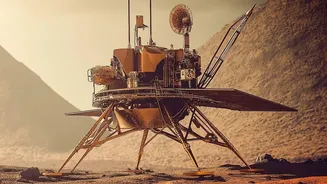
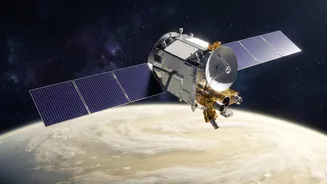
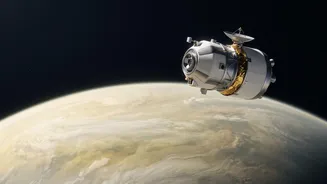
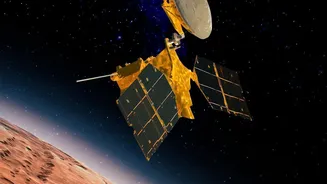
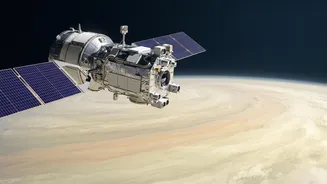
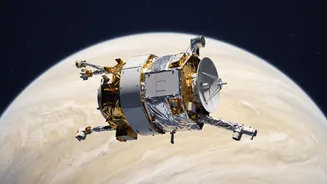
Following the monumental success of its Mars Orbiter Mission (Mangalyaan), ISRO is setting its sights on the second planet from the Sun. The Shukrayaan-1 mission, India's first dedicated venture to Venus, aims to conduct a comprehensive study of the planet from orbit.
Scheduled for a March 2028 launch, the spacecraft will embark on a journey to investigate Venus's geology, atmosphere, and its interaction with the solar wind. This mission is not just about exploring another world; it's a testament to India's growing prowess in interplanetary exploration and a crucial step in understanding why a planet so similar to Earth in size and mass took such a drastically different evolutionary path.
The Cloud-Piercing Toolkit
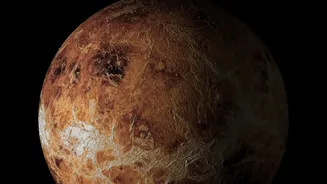
Venus’s dense clouds, made of corrosive sulphuric acid, make it impossible to observe the surface with conventional cameras. To overcome this, Shukrayaan-1 will be equipped with a powerful high-resolution Synthetic Aperture Radar (SAR). This instrument acts like a scientific flashlight, using radar waves to penetrate the thick cloud cover and map the surface in incredible detail, day or night. Its primary goals are to identify volcanic hotspots, chart geological features, and search for signs of recent activity on the planet's mysterious terrain. By peering through the clouds, the SAR will provide the foundational maps needed to understand Venus's turbulent geological history.
Decoding the Atmosphere
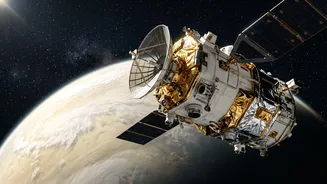
The mysteries of Venus aren't just on its surface; they're in its bizarre atmosphere. One of the mission's key objectives is to understand the structure, composition, and dynamics of the air itself. To do this, ISRO and its international partners have developed a suite of specialised sensors. The Venus Infrared Atmospheric Gases Linker (VIRAL), a collaboration with Russia, will study the composition of the upper atmosphere. Other instruments like the Venus Thermal Camera (VTC) will map temperatures at the cloud tops, helping scientists understand the planet's extreme greenhouse effect and its super-rotating winds, which whip around the planet 60 times faster than the planet itself spins.
Solving the Great Cloud Mystery
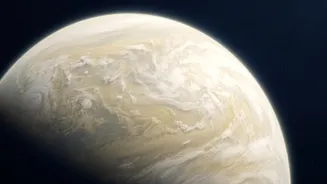
While we know the clouds are mostly sulphuric acid, a long-standing puzzle is what gives them their distinctive streaks and patches when viewed in ultraviolet (UV) light. Some scientists theorise that unknown UV-absorbing minerals, possibly containing iron, are responsible for these features. Shukrayaan-1's atmospheric instruments, including spectrometers that study how light interacts with different chemicals, will be crucial in solving this. Instruments like the Venus Atmospheric SpectroPolarimeter (VASP) and a Venus Cloud Monitoring Camera (VCMC) will analyse the chemical makeup and movement of the clouds, providing vital data to identify the mystery absorber and understand how these vast cloud decks are sustained, which may be linked to active volcanism.
The Search for Answers and Lost Water
Beyond the clouds, the mission seeks answers to one of the biggest questions in planetary science: where did Venus's water go? Evidence suggests Venus may have once had oceans, but a runaway greenhouse effect boiled them away. By studying the interaction between the solar wind and the Venusian ionosphere, instruments like the Venusian Neutrals Analyzer will investigate how the Sun's radiation strips particles from the atmosphere, a process that could explain the loss of its water over billions of years. This research offers a cautionary tale, providing invaluable insights into planetary evolution and the delicate atmospheric balance that makes a world like Earth habitable.