


A Stunning New View
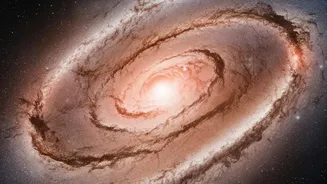
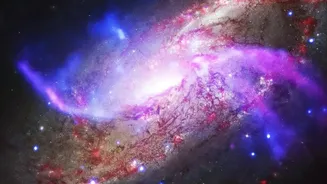
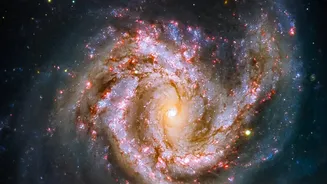
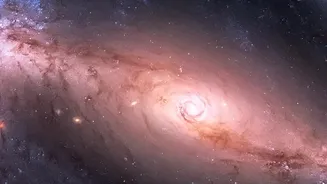
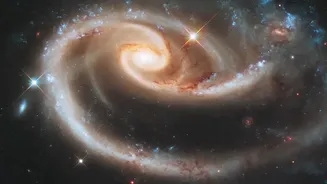
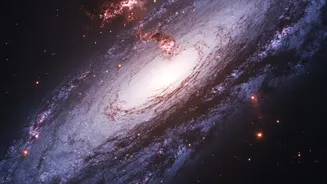
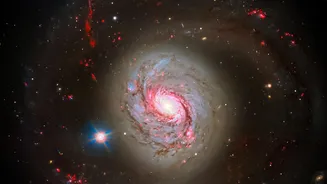
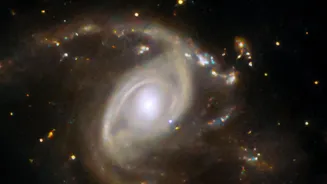
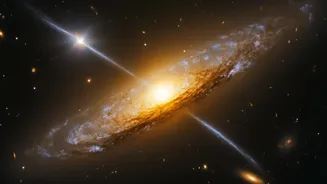
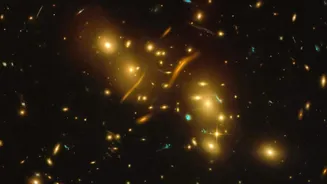
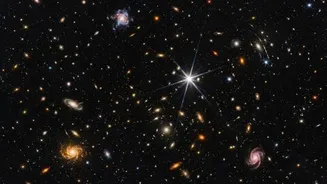
Astronomers are buzzing over a breathtaking new set of images from the James Webb Space Telescope (JWST). These are not just pretty pictures; they are detailed portraits of galaxies that existed a mere 280 to 400 million years after the Big Bang. For
decades, our theories suggested that the first galaxies would be small, clumpy, and chaotic collections of stars. But the latest observations are showing something entirely different: galaxies that are unexpectedly massive and structured, appearing far more developed than anyone predicted for that early stage of the cosmos. This glimpse into the universe’s nursery is forcing a major rethink of how quickly the first cosmic cities of stars could have formed, suggesting the universe was in a hurry to get started.
How to Look Back in Time
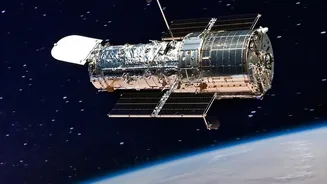
It might sound like science fiction, but looking deep into space is the same as looking back in time. Light, though it travels incredibly fast, still takes time to cross the vast distances of the universe. The light from our own Sun takes about eight minutes to reach Earth. For the most distant galaxies, that journey can take over 13 billion years. When the JWST captures light from a galaxy that is 13.5 billion light-years away, it is seeing that galaxy as it was 13.5 billion years ago. The telescope achieves this feat by looking for light in the infrared spectrum. As the universe expands, the light from distant objects gets stretched out, shifting from visible light into longer, redder wavelengths—a phenomenon known as redshift. Webb was specifically designed to capture this ancient, stretched-out light, making it a powerful time machine.
Galaxies in the Cosmic Nursery
The most recent findings show galaxies that are not only surprisingly bright and large for their age but also contain chemical elements heavier than hydrogen and helium. In astronomical terms, these heavier elements are called 'metals', and they are forged inside stars and scattered through space when those stars die. Finding these elements in such early galaxies suggests that the first generations of stars must have formed, lived, and died even earlier than our models predicted. One researcher described the finding as being akin to walking into a nursery and finding fully grown adults. These galaxies appear to have mature features like flattened disks, which astronomers thought took billions of years to develop. This discovery poses a thrilling puzzle: how did the universe build such complex structures so quickly?
Rewriting the Textbooks
These new discoveries don't disprove the Big Bang, but they do challenge our understanding of what happened next. The current model of galaxy formation, known as the Lambda-CDM model, suggests a slow, hierarchical process where small clouds of gas and dark matter gradually merge to form larger and larger galaxies over billions of years. The presence of massive, well-formed galaxies so early on suggests that this process may have been far more efficient, or that other mechanisms were at play. Perhaps stars formed more abundantly in the early universe, or the first black holes played a bigger role in accelerating galaxy growth. Scientists are now scrambling to adjust their simulations and theories to account for this accelerated development. It’s a classic moment in science where new, powerful data forces us to abandon old assumptions and embrace a more complex reality.
What Comes Next?
The work is far from over. Each new image from the JWST raises as many questions as it answers. Astronomers will now conduct follow-up studies, using the telescope's spectrographs to break down the light from these ancient galaxies. This will provide even more detailed information about their chemical composition, temperature, and the motions of their stars and gas. By studying a larger sample of these early galaxies, scientists hope to build a new timeline of cosmic evolution that matches the evidence Webb is providing. The goal is to piece together the full story of our cosmic origins, from the first stars to the formation of galaxies like our own Milky Way. This is more than just an academic exercise; it's a fundamental quest to understand where everything, including us, came from.