




Seeing the Invisible
The fundamental challenge in observing star birth is that it happens in the dark. Stars form over millions of years inside vast, cold, and incredibly dense clouds of gas and dust. These cosmic nurseries are so thick that they block visible light, the kind
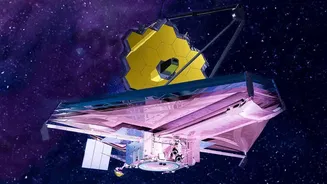
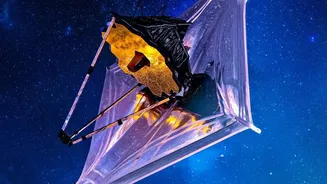
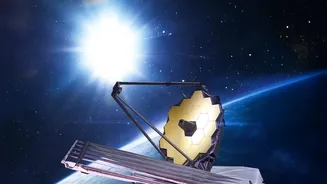
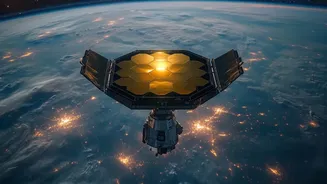
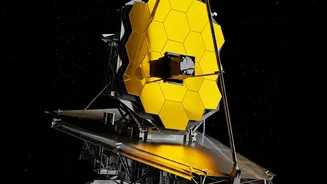
our eyes and telescopes like Hubble primarily see. It’s like trying to see a candle being lit inside a thick fog bank. For decades, these star-forming regions remained largely mysterious. But the James Webb Space Telescope (JWST) was engineered with a specific superpower: infrared vision. Infrared light has a longer wavelength than visible light, allowing it to slip past the tiny dust particles that would otherwise block the view. This ability lets astronomers peer deep inside these dusty clouds, effectively making the opaque transparent and revealing the processes that lead to star and planet formation for the first time.
Inside the Cosmic Nursery
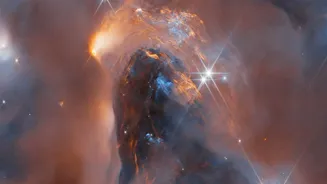
So, what exactly is Webb seeing? It's capturing the very first steps of stellar life. Deep within these clouds, dense knots of gas and dust collapse under their own gravity, forming what are known as protostars. These are infant stars, not yet hot enough to sustain nuclear fusion like our Sun, but glowing brightly in infrared as they gather mass and heat up. Recent images of regions like the Serpens Nebula, located 1,300 light-years away, showcase this process in stunning detail. Webb's Near-Infrared Camera (NIRCam) has revealed a dense cluster of newly forming stars, some only around 100,000 years old. These images show structures and details that were previously hidden, giving scientists an unprecedented census of baby stars and allowing them to study their formation mechanisms in ways that were impossible before.
Jets, Outflows, and the Tantrums of a Baby Star
One of the most dramatic signs of star birth are protostellar jets. As a young protostar spins rapidly, it ejects powerful, narrow streams of gas from its poles. These jets, sometimes called bipolar outflows, slam into the surrounding gas and dust at high speeds, creating brilliant shockwaves. In Webb's images, these jets often appear as striking red streaks, colored to represent the infrared emission from molecular hydrogen and carbon monoxide. An astonishing discovery in the Serpens Nebula was a group of these jets all aligned in the same direction, like sleet pouring down in a storm. Astronomers had long theorized that stars forming from the same collapsing cloud would spin in the same direction, but this was the first time it had been seen so directly. These jets are a crucial part of star formation, helping the protostar shed excess angular momentum so it can continue to accrete mass and grow.
Where Planets Are Born
As the protostar matures, the leftover gas and dust flattens into a rotating ring around its equator, known as a protoplanetary disk. This is the birthplace of planets. Within these swirling disks, particles of dust and ice begin to clump together, gradually building up into larger and larger bodies—from pebbles to planetesimals and eventually, full-fledged planets. Webb’s powerful instruments can study the composition of these disks, detecting the presence of water, carbon monoxide, and complex organic molecules—the raw materials for life as we know it. By observing these planetary cradles, scientists are gaining invaluable insights into how solar systems, including our own, take shape. Webb’s view provides a window into what our Sun and Solar System may have looked like in their infancy, more than 4.5 billion years ago.