





Why Put Data Centres in Space?
On Earth, data centres are the power-hungry backbone of the internet and the AI revolution. They consume enormous amounts of electricity for processing and cooling, straining power grids and often relying on fossil fuels. The pitch for moving them to
low Earth orbit is simple: up there, solar power is near-constant and far more potent than on the ground. Companies like SpaceX, Google, and Blue Origin are exploring concepts, arguing that space-based data centres could be a sustainable solution to Earth's growing energy needs for computing. Some proposals are vast, with SpaceX alone filing with the U.S. Federal Communications Commission (FCC) for a constellation of up to one million satellites. The logic is that by moving the industrial work of computation into orbit, we reduce the environmental footprint on Earth.
An Existential Threat to Astronomy
While the idea sounds futuristic, astronomers describe it as an existential threat. The primary problem is light pollution. To generate enough power, these orbital data centres would require enormous solar panels, potentially spanning kilometres. These massive, reflective surfaces would catch the sun's rays and shine brightly, appearing like slow-moving, intensely bright stars from the ground, especially during the twilight hours after sunset and before sunrise. Researchers estimate some could be as radiant as Venus, one of the brightest objects in the night sky. These bright trails would streak across images taken by ground-based telescopes, rendering valuable data useless. For observatories conducting long-exposure surveys of faint and distant galaxies, like the Vera C. Rubin Observatory, the constant passage of thousands of bright satellites could make their mission impossible.
A Sky Full of Satellites
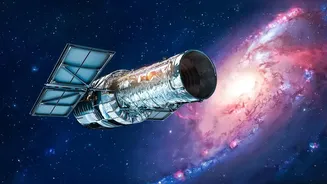
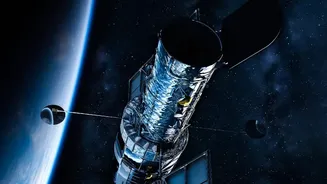
The issue is not just a few bright objects but the cumulative effect of potentially hundreds of thousands of new satellites. Astronomers are already struggling with the impact of mega-constellations like SpaceX's Starlink, which currently has thousands of satellites in orbit. The addition of up to a million more, many of which would be significantly larger and more reflective than existing communication satellites, would fundamentally alter the night sky for everyone. Projections suggest these constellations could form visible belts of light moving across the sky, potentially drowning out natural features like the Milky Way. The problem isn't limited to visible light; the satellites also broadcast radio signals, which can leak into protected frequencies and blind radio telescopes trying to capture faint cosmic signals. Even space telescopes like Hubble are not immune, as satellites in higher orbits can pass through their field of view.
A Frontier Without Rules
This looming conflict highlights a significant gap in governance. International space law, largely based on the 1967 Outer Space Treaty, requires nations to supervise the activities of their private companies but lacks specific rules for managing light pollution or the sheer density of objects in low Earth orbit. In the U.S., regulatory bodies like the FCC license satellite communications but have been criticized for not conducting thorough environmental reviews for these massive new constellation proposals. Scientific and environmental groups have petitioned for stronger oversight, arguing that launching such projects without assessing their impact on the atmosphere, wildlife, and the sky is reckless. This has led to a broader debate about who should regulate 'novel' space activities that don't fit neatly into existing categories like launch or communications, such as orbital servicing, manufacturing, and data processing.