



The Universe’s Chemical Cookbook
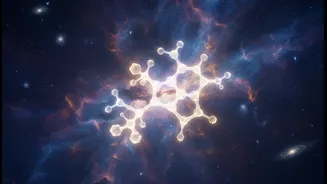
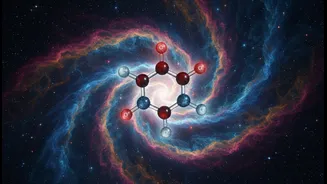
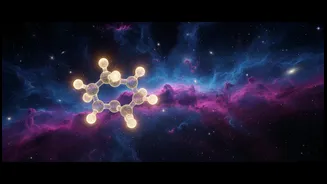
When scientists talk about the 'building blocks of life', they are often referring to complex organic molecules (COMs). Don't let the name intimidate you; in astrochemistry, 'complex' simply means a carbon-based molecule made of six or more atoms. These
are the crucial starting ingredients for creating biologically essential components like amino acids, proteins, and sugars. For decades, astronomers have found these molecules drifting in the cold, dark clouds between stars, but a complete picture of how and where they form has remained elusive. The prevailing theory held that they were created in relatively calm, cold environments, but new findings are challenging that assumption.
A Breakthrough in a Violent Galaxy
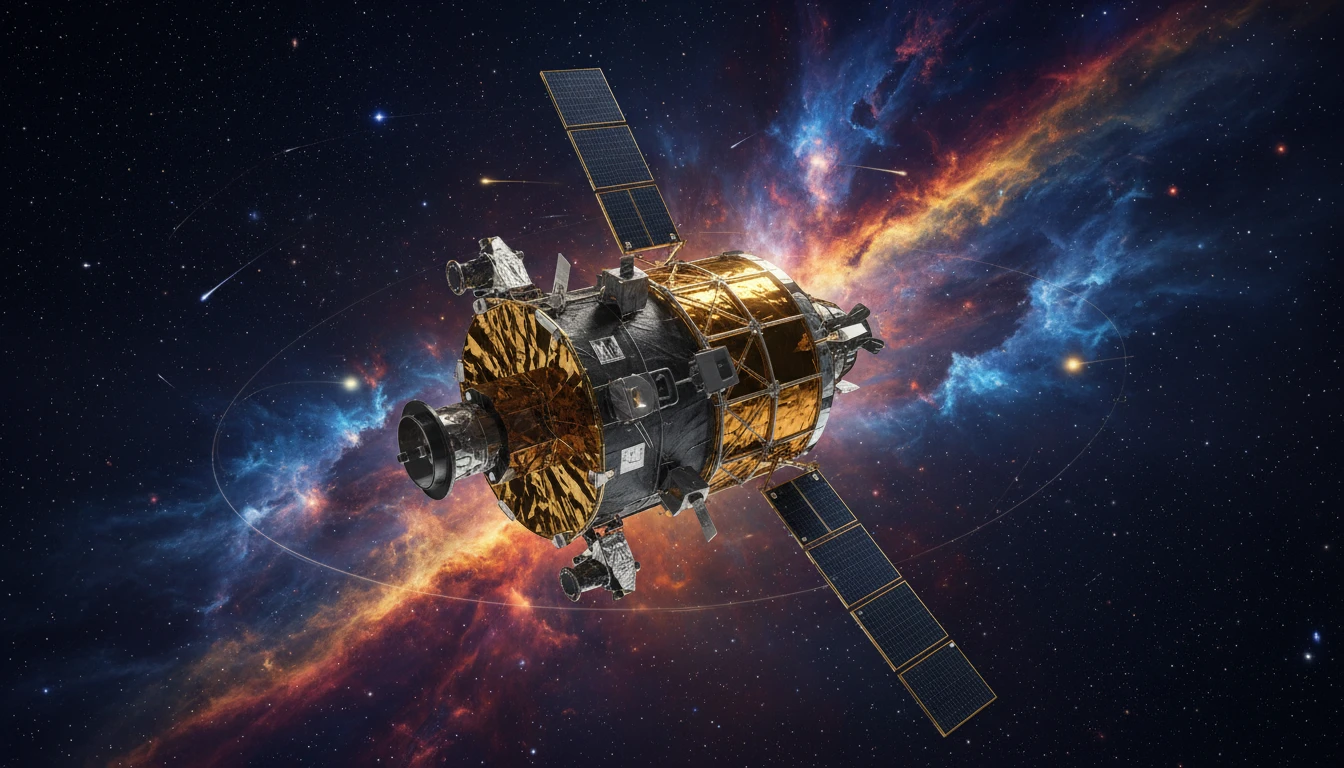
A recent study has provided a startling new piece of the puzzle. Using the powerful James Webb Space Telescope (JWST), astronomers peered deep into the heart of an ultra-luminous infrared galaxy named IRAS 07251-0248. This type of galaxy is an incredibly turbulent place, shrouded in thick dust and powered by a supermassive black hole at its center. Scientists were stunned to find a rich collection of small organic molecules, including benzene, methane, and acetylene, thriving in this harsh environment. The discovery, published in a leading scientific journal, showed a level of chemical complexity far higher than theoretical models predicted for such a violent cosmic setting.
Forged in Ice and Starlight
So how do these complex molecules come to be? The process often starts with some of the most abundant real estate in the universe: dust. Tiny grains of cosmic dust act like miniature, frozen laboratories. In the immense cold of space, simple molecules like water, carbon monoxide, and ammonia freeze onto these dust grains, forming an icy mantle. This is where the magic happens. Ultraviolet radiation from nearby newborn stars bombards these icy specks, providing just enough energy to break the simple molecules apart and encourage them to recombine into more complex and stable structures. Lab experiments on Earth have even shown that irradiating simple ices can lead to the formation of peptides, the short chains of amino acids that form proteins.
From Cosmic Clouds to New Worlds
Once formed, these life-seeding molecules don't just stay in their interstellar nurseries. The very clouds of gas and dust that create them are destined to collapse under gravity to form new stars and planetary systems. As this material swirls into a protoplanetary disk around a young star, the enriched dust grains are incorporated into an assortment of asteroids, comets, and eventually, planets. This process provides a direct delivery mechanism for the fundamental ingredients of life. It suggests that planets like Earth may be seeded with a starter kit of organic chemistry from the very moment they form. Discoveries of complex organics in our own solar system's meteorites support this cosmic delivery theory.
A Cosmos Rich with Potential
The latest findings are part of a wave of discoveries, many enabled by the JWST, that are painting a picture of a universe teeming with prebiotic potential. In late 2025, astronomers used the telescope to detect complex organic molecules, including ethanol and acetic acid (the stuff in vinegar), frozen in the ice around a young star in a neighboring galaxy for the first time. This shows that the chemical processes that lead to life's ingredients are not unique to the Milky Way. Finding these molecules in such diverse environments—from the frigid clouds where stars are born to the chaotic cores of brilliant galaxies—strongly suggests that the raw materials for life are common across the cosmos.