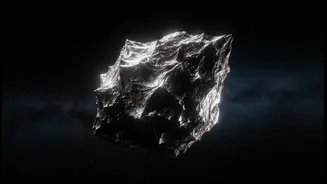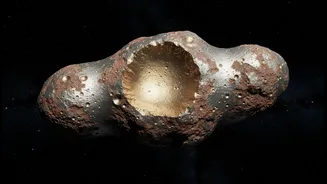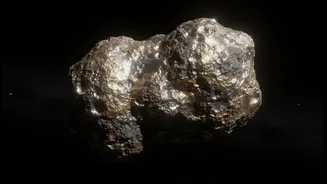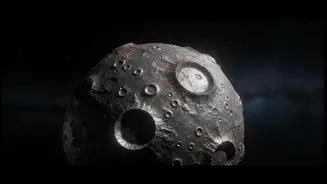



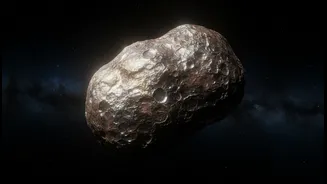


A Metal World in the Asteroid Belt
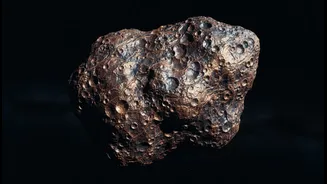
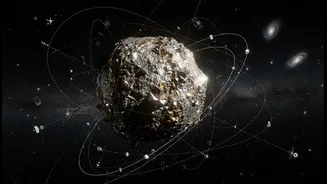
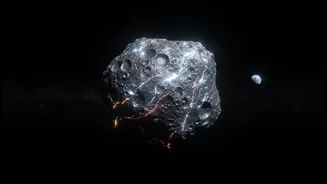
Psyche is one of the most massive objects in the main asteroid belt, measuring about 280 kilometers across at its widest point. Unlike its neighbours, which are mostly rock or ice, Psyche seems to be dense and metallic. For years, this has made it a prime
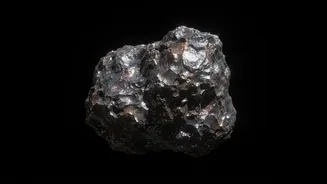
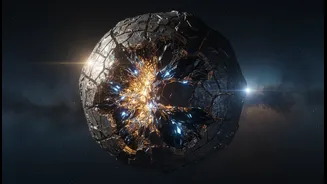
candidate for a very special type of celestial body: the stripped core of a protoplanet. The idea is that billions of years ago, a young world in the process of forming was smashed apart by violent collisions. While its rocky mantle was blasted away, its durable metallic core survived. If true, studying Psyche would be like getting a direct look at the engine room of a planet like Earth, whose own core is forever hidden from us miles beneath our feet.
The Core Theory Gets Complicated
For a long time, the leading hypothesis was that Psyche was a solid lump of iron and nickel. However, new data from advanced ground-based telescopes and sophisticated computer models have added compelling new layers to the story. One of the biggest puzzles arose from more precise density measurements. While dense, Psyche isn't quite as dense as a solid iron-nickel core should be. Some calculations suggested its body would need to be over 50% empty space, or porous, to match the observations, which seems unlikely for such a large object.
What the New Data Reveals
Recent research provides a more nuanced picture. Instead of a solid object, Psyche may be more of a metallic "rubble pile"—a collection of metal and rock that was shattered and then pulled back together by its own gravity. Maps created using thermal observations show a surprisingly varied surface. Some regions are highly metallic, while others appear to be covered in silicate rock, like sand. This has led to theories of "ferrovolcanism," where metallic lava from a cooling core may have erupted onto the surface. Furthermore, data from the James Webb Space Telescope recently detected hydrated minerals, which could be evidence of water-rich asteroids crashing into Psyche, or could even suggest Psyche formed in a different, colder part of the solar system than previously thought.
Still the Heart of a Planet?
So, what does this all mean? The new evidence doesn't necessarily disprove the remnant core theory but certainly refines it. Psyche is likely not a simple, intact core that was neatly unwrapped. Instead, it seems to be the battle-scarred survivor of a violent past. It's still fundamentally a piece of a planetary interior, but one that was likely broken, mixed with rocky debris from impacts, and possibly reassembled. The presence of both rocky and metallic regions, and the lower-than-expected density, all point toward a body that is a complex mixture of materials, with a metal content estimated to be between 30% and 60%. This mix of rock and metal supports the idea that we are looking at the aftermath of a catastrophic disruption that blended core and mantle fragments.
The Journey to Know for Sure
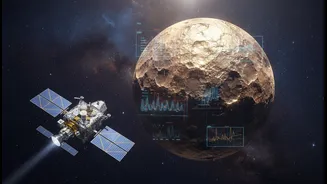
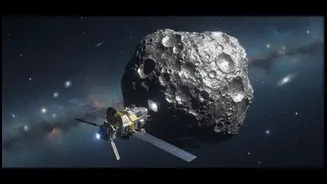
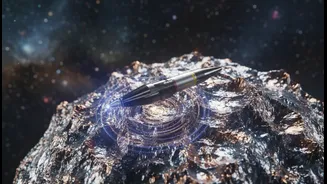
Ultimately, observation from Earth can only tell us so much. The good news is that we won't have to wonder for too much longer. NASA's Psyche mission launched in October 2023 and is currently on its way to the asteroid. The spacecraft, also named Psyche, recently performed a crucial gravity-assist flyby of Mars in May 2026 to gain speed and adjust its trajectory. It is now on a direct path to the asteroid belt, with arrival scheduled for August 2029. Once it arrives, the orbiter will spend nearly two years mapping the surface in detail, analyzing its composition with a suite of advanced instruments, and measuring its gravity field. These direct observations will finally help us understand the true nature and origin of this unique metal world.