



The Hunt for Hidden Threats
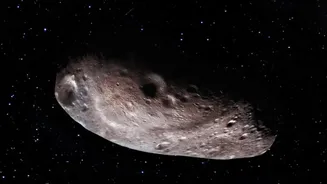
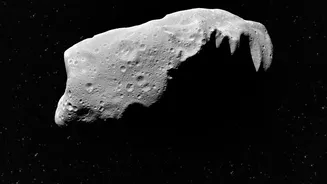
For decades, NASA and its international partners have been tasked with finding and cataloging near-Earth objects (NEOs), which are asteroids and comets whose orbits bring them within about 50 million kilometers of Earth. The goal is to identify potentially
hazardous objects—especially those larger than 140 meters, which could cause significant regional damage—long before they pose a threat. In 2016, NASA formalized these efforts by creating the Planetary Defense Coordination Office (PDCO) to manage the search and coordinate any necessary response. This isn't just about avoiding a catastrophe; studying these celestial bodies also provides valuable clues about the formation of our solar system.
A Network of Robotic Eyes
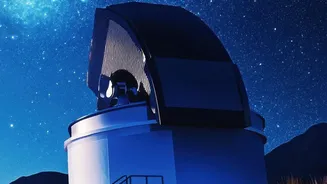
The backbone of modern asteroid detection is a group of dedicated, ground-based survey telescopes. Systems like the Catalina Sky Survey (CSS) in Arizona and the Panoramic Survey Telescope and Rapid Response System (Pan-STARRS) in Hawaii are responsible for the vast majority of new NEO discoveries. These aren't your typical telescopes for staring at a single galaxy. They have extremely wide fields of view, allowing them to scan huge swaths of the sky every night. Another key player is the Asteroid Terrestrial-impact Last Alert System (ATLAS), with telescopes in Hawaii, Chile, and South Africa. ATLAS is designed to scan the entire visible sky nightly, looking for smaller asteroids that might only become visible days or weeks before a potential impact.
From Pixels to Predictions
So, how do they find a tiny, moving rock against a backdrop of billions of stars? The process is a marvel of automation. A telescope takes a series of images of the same patch of sky, typically several minutes apart. Sophisticated software then compares these images, looking for anything that has moved. A potential asteroid will appear as a faint dot that has shifted its position relative to the fixed stars. Once a candidate is flagged, the data is sent to the Minor Planet Center, a global clearinghouse for such observations. Other astronomers around the world then conduct follow-up observations to confirm the object and gather more data points. With enough observations, scientists at centers like NASA's Center for Near Earth Object Studies (CNEOS) can calculate the object's orbit with high precision and predict its path for decades to come, determining if it poses any risk to Earth.
The Next Generation of Sentinels
The current system is effective, but it has limitations. Ground-based telescopes can be hampered by weather and are blind to asteroids approaching from the direction of the Sun. That’s why the next leap forward involves moving the search into space. The Vera C. Rubin Observatory in Chile, set to begin its full survey soon, is expected to revolutionize the field, potentially discovering millions of new asteroids. Its massive camera and rapid scanning speed will dramatically increase detection rates. Even more crucial is NASA's upcoming NEO Surveyor, an infrared space telescope scheduled to launch no earlier than September 2027. By detecting the heat signature of asteroids, NEO Surveyor will be able to spot objects that are too dark to be seen by visible-light telescopes on the ground. It will be positioned at a stable point between the Earth and Sun, allowing it to find asteroids that are currently hidden in the Sun's glare.