





The Case of the 'Disappearing' Planet
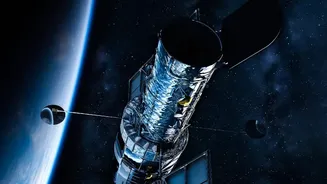
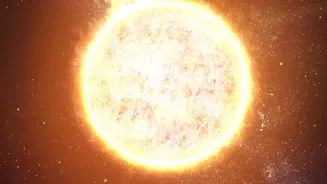
Astronomers find most exoplanets using the transit method. They stare at a star and wait for a tell-tale dip in its brightness. This dimming means a planet has passed in front of it from our point of view. For seven years, from 2019 to 2026, NASA's TESS
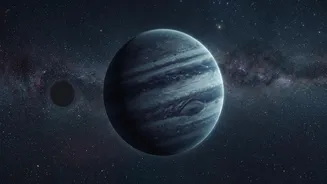
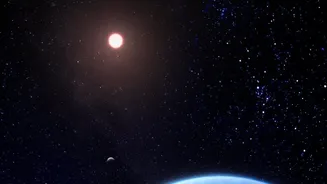
space telescope watched a 'hot Jupiter' called TOI-2535 b do just that. This Jupiter-sized planet, located about 1,000 light-years away, orbits its star in a blistering 8.25 days. But then, in March 2026, the transits stopped. The planet, which astronomers had been carefully observing, seemingly disappeared.
Not Lost, Just Hiding
So, where did it go? The planet didn't explode or get consumed by its star. The truth is far more interesting. Over the years they were watching, astronomers noticed that TOI-2535 b wasn't keeping a perfect schedule. Its transits would arrive up to six hours early or six hours late, one of the largest timing variations ever seen for this type of planet. The transits also became shorter and shallower over time. This wasn't a faulty clock; it was a clue. The planet's orbit wasn't just speeding up and slowing down; it was also tilting. It wobbled right out of our line of sight, meaning its transits no longer cross the face of its star from our perspective on Earth.
The Unseen Hand: Transit Timing Variations
This phenomenon of irregular transits is known as Transit Timing Variation, or TTV. In a simple, one-planet system, a planet's orbit should be incredibly regular. But when other planets are present, their gravitational pulls can tug on the transiting planet, causing it to speed up or slow down in its orbit. This gravitational dance means the transits don't happen at perfectly spaced intervals. The historical precedent for this is right here in our solar system; tiny deviations in the orbit of Uranus in the 1820s allowed astronomers to correctly predict the existence and location of Neptune long before it was ever seen.
A Hidden Companion Planet
The massive timing variations and the orbital wobble of TOI-2535 b pointed to only one conclusion: it isn't alone. Scientists believe there is another large, unseen planet in the system, catalogued as TOI-2535 c. The two planets are locked in a gravitational tug-of-war, with their orbits tilted relative to each other. This mutual pulling causes both of their orbits to precess, or wobble, like a spinning top that is starting to slow down. The interaction is so strong that it caused TOI-2535 b's orbital plane to tilt completely out of our line of sight in just a few years—the fastest such change ever observed for a planet around a single star.
A Tool for Discovery
Far from being a problem, TTVs are a powerful tool for astronomers. They turn a single transiting planet into a probe for an entire planetary system. By precisely measuring how early or late a transit occurs, scientists can deduce the mass and orbit of other, non-transiting 'hidden' planets in the system. In the case of TOI-2535, the 'disappearance' of one planet is direct evidence for the existence of another. This chaotic dance also provides clues about how these systems form, suggesting that 'hot Jupiters' may not be thrown violently towards their star, but instead migrate inwards more slowly, influenced by their planetary neighbours.
What Happens Next?
While TOI-2535 b may have vanished from view for now, astronomers are patiently waiting. Based on their models, they predict its wobbling orbit will bring it back into a transiting alignment in the next 30 to 50 years. Even more exciting is the possibility that its hidden companion, TOI-2535 c, might have its orbit tilted into our line of sight much sooner. The case of the 'missing' planet is a perfect example of how in science, an unexpected result or a broken pattern often leads to a deeper and more profound understanding of the universe.