



What the Webb Telescope Actually Found
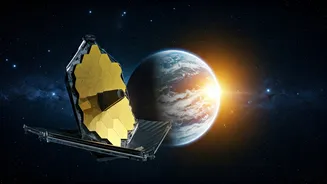
The latest buzz comes from a planet far beyond our solar system, named K2-18 b. Using the powerful James Webb Space Telescope (JWST), astronomers analysed the light passing through its atmosphere. They confirmed the presence of carbon-bearing molecules,
including methane and carbon dioxide. More excitingly, the data showed a possible hint of a rare molecule called dimethyl sulfide (DMS). This isn't the first time Webb has peered at this planet, but each new look adds another piece to a fascinating puzzle. The presence of these specific gases is significant because it points to a potentially complex and active atmosphere on a world that might have a large ocean.
Meet the Planet: K2-18 b
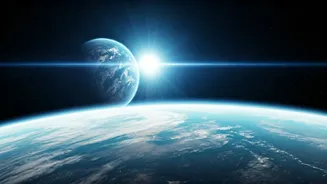
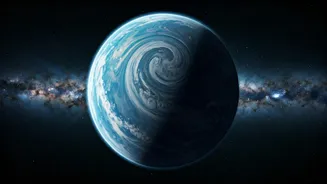
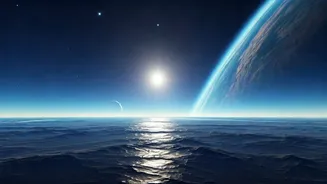
So, where is this place? K2-18 b is an exoplanet located about 120 light-years from Earth in the constellation Leo. It's what's known as a 'sub-Neptune' or 'super-Earth,' weighing in at about 8.6 times the mass of our own planet. Crucially, it orbits its star—a cool red dwarf—within the habitable zone. This is the region where temperatures are just right for liquid water to potentially exist on the surface. Scientists have dubbed worlds like K2-18 b 'Hycean planets'—a new class of potentially habitable world with a water-rich surface under a hydrogen-heavy atmosphere.
The 'Twilight Zone' Explained
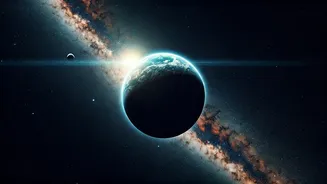
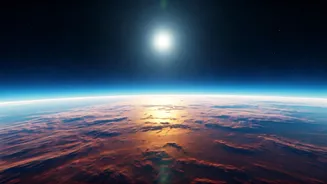
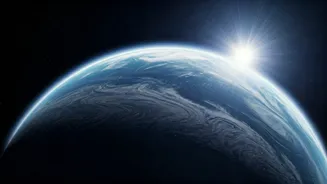
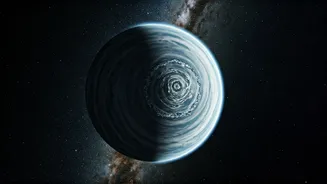
This is where the 'twilight' part of the headline comes in. Because K2-18 b is so close to its star, it's likely 'tidally locked.' This means one side of the planet permanently faces the star in perpetual daylight, while the other side is locked in endless, freezing night. Between these two harsh extremes lies a narrow ring of constant twilight known as the 'terminator zone'. Here, the sun would hang eternally on the horizon. Scientists believe this twilight band could be the most promising place for life, offering a 'just right' climate where it's neither boiling hot nor frozen solid, allowing liquid water to potentially flow.
Why Dimethyl Sulfide Is a Big Deal
Now, let's talk about that molecule: dimethyl sulfide (DMS). The reason astronomers are so excited about the possibility of finding it is simple: here on Earth, DMS is overwhelmingly produced by life. Most of the DMS in our atmosphere is emitted by phytoplankton in marine environments. This makes it a powerful 'biosignature'—a substance that provides evidence of life. Finding methane and CO2 is interesting, but finding them alongside DMS on a potentially ocean-covered world is the closest we've come to a potential sign of biological activity on an exoplanet.
So, Is It Aliens?
Let's pump the brakes. While incredibly exciting, this is not a confirmation of alien life. The detection of DMS is still tentative and requires more data to be confirmed. Scientists are rightly cautious. The search for life elsewhere is one of the biggest questions in all of science, and the standard for proof is extraordinarily high. It's possible that the signal is a statistical fluke or that there's an unknown geological or chemical process that can create DMS without life. For now, it's a 'maybe'—but a very compelling one that gives scientists a clear target for future investigation.
What Happens Next in the Search?
The discovery is a roadmap for what to do next. Researchers will use the JWST to stare at K2-18 b again, using different instruments to confirm if the DMS is really there and in what quantity. They will also expand their search to other similar planets. This finding helps astronomers refine their models and understand what kinds of environments are most likely to host life. Even if this specific lead doesn't pan out, it proves that our technology is now capable of detecting these subtle signs in the atmospheres of worlds light-years away, marking a new chapter in our cosmic detective story.