





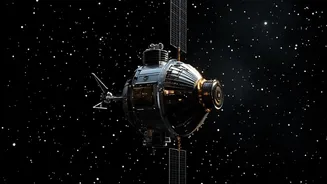
A Journey to an Ocean Moon
Launched in October 2024, the Europa Clipper spacecraft is undertaking a long and complex voyage to the Jupiter system, with an expected arrival in April 2030. To get there, it’s using a clever path that involves gravity assists—slingshot manoeuvres around
other planets—to build up enough speed. After a flyby of Mars in early 2025, it is scheduled to swing by Earth in December 2026 for its final push toward the outer solar system. Unlike a mission that would orbit the moon directly, Clipper will enter a long, looping orbit around Jupiter itself. This path is a strategic choice designed to protect the spacecraft's sensitive electronics from Jupiter's punishing radiation belts. From this orbit, it will perform nearly 50 close flybys of Europa, dipping down to altitudes as low as 25 kilometres to scan the surface before retreating to safety.
Why This Icy World?
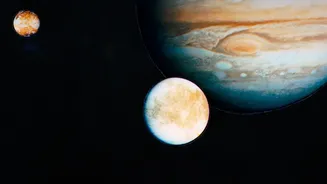
So, what makes this particular moon, one of Jupiter's 95, so special? For decades, scientists have gathered strong evidence suggesting that beneath Europa’s deeply frozen, fractured crust lies a massive, global ocean of liquid saltwater. Astonishingly, this hidden ocean may contain more than twice the amount of water found in all of Earth’s oceans combined. Life as we know it has three basic requirements: liquid water, essential chemical elements, and a source of energy. Europa appears to have all three. The water is there in abundance. The chemical building blocks for life, such as carbon and sulfur compounds, are believed to exist on its surface and could be cycled into the ocean below. The energy doesn't come from the sun, which is too distant to warm this world. Instead, it comes from Jupiter's immense gravity, which constantly squeezes and stretches Europa, generating heat through tidal flexing. This process could not only keep the ocean liquid but also drive hydrothermal vents on the seafloor, similar to those on Earth that teem with life independent of sunlight.
The Astrobiologist's Toolkit
Europa Clipper is not designed to find life itself, but to determine if the conditions for life exist. To do this, it carries a suite of nine powerful science instruments shielded inside a protective vault. The mission has three main scientific goals: to confirm the ocean's existence and understand its properties, to investigate the moon's composition, and to characterize its geology. An ice-penetrating radar instrument called REASON will probe the icy shell, measuring its thickness and searching for pockets of liquid water, potentially revealing if an ocean lies beneath. Spectrometers will analyze the composition of the surface ice, looking for salts and organic molecules that might give clues about the chemistry of the water below. A magnetometer will measure the strength and direction of Europa's magnetic field, which can help determine the ocean's depth and saltiness.
Sniffing for Clues in Space
Perhaps most excitingly, Clipper is equipped to analyze material ejected from Europa directly. The Hubble Space Telescope has previously detected hints of water vapour plumes erupting from the moon's surface. If Clipper can fly through one of these plumes, its mass spectrometer, MASPEX, will be able to 'sniff' the gases, searching for organic molecules and other chemical signs of a habitable environment. Another instrument, the Surface Dust Mass Analyzer (SUDA), will collect and study tiny particles of ice and dust blasted off Europa’s surface by micrometeorites. This provides another ingenious way to sample the moon's surface composition without the immense challenge and risk of landing on it. By studying this ejected material, scientists can get a direct taste of Europa's chemistry, potentially including materials that originated from the ocean below.
Redefining the Search for Life
The Europa Clipper mission represents a pivotal moment in astrobiology. Whether it finds a warm, chemically rich ocean or a cold, geologically quiet one, the results will be transformative. Confirmation of a habitable environment would instantly make Europa the most compelling target in the solar system for a future mission designed to actually search for life, perhaps with a lander or a cryobot that could one day melt its way through the ice. Even if the data suggests Europa is less active than hoped, it will provide crucial information for understanding the limits of habitability on ocean worlds throughout the galaxy. By thoroughly assessing the potential for life on this distant moon, the mission will help answer one of humanity's oldest and most profound questions: Are we alone? The spacecraft's findings, whatever they may be, will shape the direction of planetary exploration for decades to come.