



The Allure of a Hidden Ocean
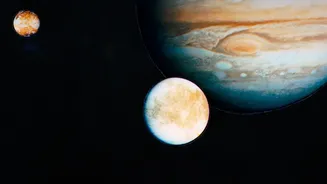
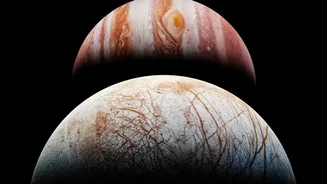
Europa has captivated scientists for decades. Data from previous missions, like Galileo, strongly suggests the existence of a global ocean of liquid saltwater hidden beneath a thick crust of ice. This ocean may contain more than twice the amount of water found
in all of Earth's oceans combined. On our own planet, wherever we find water, we find life. This simple fact makes Europa one of the most compelling destinations in our solar system to investigate for habitability—the right conditions for life to exist. The main goal of the Europa Clipper mission is to determine if this distant moon has the three key ingredients believed to be necessary for life: liquid water, essential chemical elements, and an energy source.
Plumes: A Shortcut to the Deep
Getting to that ocean is a monumental challenge, as the ice shell could be miles thick. However, observations from telescopes like the Hubble Space Telescope have hinted that Europa might be venting its ocean into space. These suspected plumes of water vapor could erupt from cracks in the ice, offering a tantalizing opportunity for a passing spacecraft to sample the ocean's contents without ever landing. This provides a direct path to analyzing the chemistry of the hidden sea. While the evidence for these plumes is intriguing, it isn't yet definitive. Because of this, a major part of Clipper’s mission is to first confirm if and where these plumes exist before flying through them to collect data.
Clipper’s Plume-Hunting Toolkit
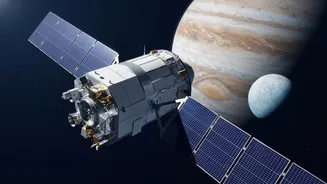
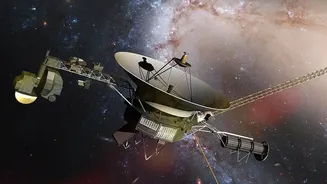
To accomplish this task, Europa Clipper is equipped with a suite of nine advanced scientific instruments. For analyzing plumes, two are especially critical: the SUrface Dust Analyzer (SUDA) and the MAss Spectrometer for Planetary EXploration (MASPEX). These instruments are considered the mission's "hands-on" experiments because they will directly collect particles and gases. SUDA is designed to scoop up tiny grains of ice and dust, while MASPEX acts like a sensitive nose, "sniffing" the gases in Europa's faint atmosphere and any plumes it encounters. Other instruments, like the Europa Ultraviolet Spectrograph (Europa-UVS), will also help by searching for the telltale ultraviolet signature of water vapor plumes against the backdrop of space.
How to 'Taste' a Plume
During its dozens of low-altitude flybys, some as close as 25 kilometers from the surface, Clipper will fly directly through any plumes it finds. As it does, the funnel-shaped SUDA instrument will collect tiny ice grains. Inside SUDA, these grains are vaporized and electrically charged (ionized), allowing the instrument to measure their mass and composition with extreme precision. This process will reveal the chemistry of the material, allowing scientists to identify any salts or organic compounds frozen within the ice. Finding salts would provide clues about the ocean's salinity, while detecting complex organic molecules would be a major step in assessing whether the ocean could support life.
How to 'Sniff' for Clues
At the same time, the MASPEX instrument will analyze the gases within the plume. It works by collecting gas molecules, sorting them by their mass, and identifying what they are. This allows it to create a chemical inventory of the plume, searching for organic molecules that could be building blocks for life or even chemical food sources for microbes. This instrument is so sensitive it can study not only potential plumes but also Europa's incredibly thin atmosphere, which is formed by particles sputtering off the surface. By combining data from both MASPEX and SUDA, scientists can build a detailed picture of the materials coming from below the ice.
The Search for Habitability
It’s important to note that Europa Clipper is not a life-detection mission. Its primary purpose is to thoroughly investigate Europa's habitability. The data from its plume analysis—along with measurements of the ice shell thickness from its radar instrument and maps of surface temperatures—will help scientists determine if the ocean possesses the right chemistry and energy to be a habitat. Launched in October 2024, the spacecraft is on a long journey that includes gravity assists from Mars and Earth before it arrives in orbit around Jupiter in April 2030. From there, it will begin its series of close flybys of Europa, seeking answers to one of humanity’s oldest questions.