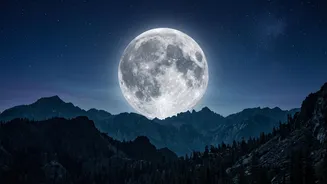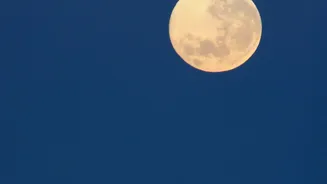

It’s a universal experience: a full moon crests the horizon, looking impossibly large and cinematic. Yet, a photo of the same scene reveals a modest, distant disc. What’s going on? The answer is a trick of the mind, not the sky.
Your First Guess Is Probably Wrong
Let's get the most common
misconception out of the way first. Many people assume the Earth's atmosphere acts like a magnifying glass, making the Moon appear larger when it’s low in the sky. It’s a logical thought, but it's incorrect. Atmospheric distortion does affect the low-hanging Moon, but it actually makes it appear slightly more squashed and oval-shaped, not bigger. In fact, due to geometry, the Moon is physically farther away from you when it's on the horizon than when it's directly overhead, meaning it should technically appear slightly smaller. So, if it's not a physical phenomenon, what is it? The culprit isn't out there in space; it’s inside your head.
Your Brain, The Deceptive Storyteller
The leading explanation for the Moon illusion is known as the 'apparent distance' hypothesis. When the Moon is high in the sky, it hangs in a vast, empty expanse. With no other visual cues for scale, your brain perceives it as a relatively close object against a featureless backdrop. However, when the Moon is on the horizon, it’s framed by objects you understand—trees, buildings, mountains. Your brain sees these objects and knows they are far away. Because the Moon sits 'behind' or 'among' these distant objects, your brain is tricked into believing the Moon must be even farther away.
The Classic 'Ponzo Illusion' at Play
This mental shortcut is a well-documented optical trick called the Ponzo illusion. Imagine two identical horizontal lines drawn on a set of converging railroad tracks. The line drawn where the tracks are closer together appears much longer than the one drawn where the tracks are wider, even though they are the same length. Your brain uses the converging lines as a depth cue, interpreting the 'upper' line as being farther away and therefore scaling up its perceived size. The Moon illusion works on the same principle. The horizon, with its terrestrial objects, acts like the converging railroad tracks, telling your brain the Moon is very distant. Since the actual image hitting your retina is the same size as the overhead Moon, your brain concludes, 'If it’s that far away and still looks this big, it must be enormous!' and inflates its perceived size.
Why Your Camera Isn't Fooled
So why does your smartphone fail to capture this magnificent spectacle? Because a camera doesn't have a brain. It has no learned context for trees, buildings, or distance. It simply records the raw optical data: the light and the angles. And in terms of angular size—the amount of space an object takes up in your field of vision—the Moon is always about half a degree wide, whether it's on the horizon or at its zenith. A photograph simply captures that half-degree speck. Those stunning viral photos of a giant Moon behind a city skyline are almost always created using a powerful telephoto lens from a great distance, which compresses the perspective and makes the Moon appear artificially large relative to the foreground objects. A standard camera lens, like the wide-angle one on your phone, does the opposite, making the Moon look disappointingly tiny.