




Look up. The sky directly above you feels surprisingly close. Now look toward the horizon. It feels impossibly vast and far away. But why? The sky isn't a physical ceiling. The illusion is a powerful trick of the mind that has baffled us for centuries.
Your Brain Thinks the Sky is a Flattened Dome
The core of the issue is that our brains don't perceive the sky as a perfect hemisphere, like half of a giant beach ball. Instead, we instinctively see it as a flattened dome or a shallow bowl. Think about it: when you look straight up to the zenith, there are no visual cues to give you a sense of scale. It’s just an empty expanse. But when you look toward the horizon, your line of sight is filled with trees, buildings, mountains, and clouds stretching into the distance. All of this information tells your brain that the horizon is very, very far away. Because of this, our brains model the sky as being much more distant at the horizon than it is directly overhead. This idea isn't new; it was described as early as the 11th century by the scientist Ibn al-Haytham.
The 'Apparent Distance' Hypothesis
This leads to the most widely accepted explanation, known as the 'apparent distance' hypothesis. This theory states that our brains use the terrain and objects on the ground as a ruler. Because the ground between you and the horizon is filled with things we know are far away, the brain concludes the sky at that point must also be extremely distant. The sky at the zenith, however, has no such reference points. It's a blank canvas. Lacking any information to the contrary, our brain defaults to perceiving it as closer. Experiments have shown that this effect holds true: a space filled with objects is perceived to be more extended than an empty space of the same size.
Meet the Ponzo Illusion
A classic psychological trick called the Ponzo illusion helps visualize what’s happening. Imagine two identical horizontal lines drawn across a set of converging railroad tracks. The line drawn higher up, where the tracks appear to narrow, will look significantly longer than the line drawn closer to you. Even though they are the same length, your brain uses the perspective cues of the tracks to make a judgment. It knows that an object farther down the tracks should look smaller, so if it appears the same size, it must actually be bigger. This is what happens with the sky. Your brain sees the horizon as the 'far away' part of the railroad tracks. Since the sky there doesn't 'shrink', your brain concludes it must be vast and distant.
It Explains the Giant Moon, Too
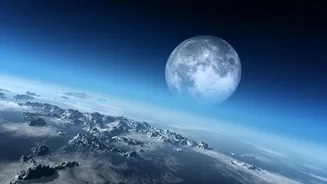
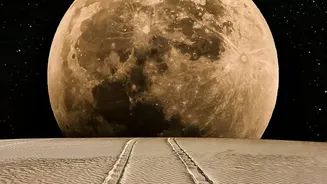
This same exact principle is why we experience the famous 'Moon illusion', where a full moon on the horizon looks enormous compared to when it's high in the sky. Photographically, the Moon is the same size in both positions—in fact, it's technically about 1.5% farther away at the horizon. But your brain doesn't know that. It sees the Moon near the horizon, surrounded by tiny-looking trees and buildings, and applies the Ponzo illusion. It thinks, 'If the Moon is that far away and still takes up so much space, it must be gigantic!' When the Moon is high in any featureless sky, there are no distance cues, so your brain perceives it as smaller and closer. You can prove it's an illusion by holding a small object at arm's length to cover the Moon; you'll see it covers the same amount whether the Moon is low or high.