

A Cosmic Detective Story
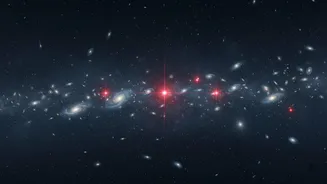
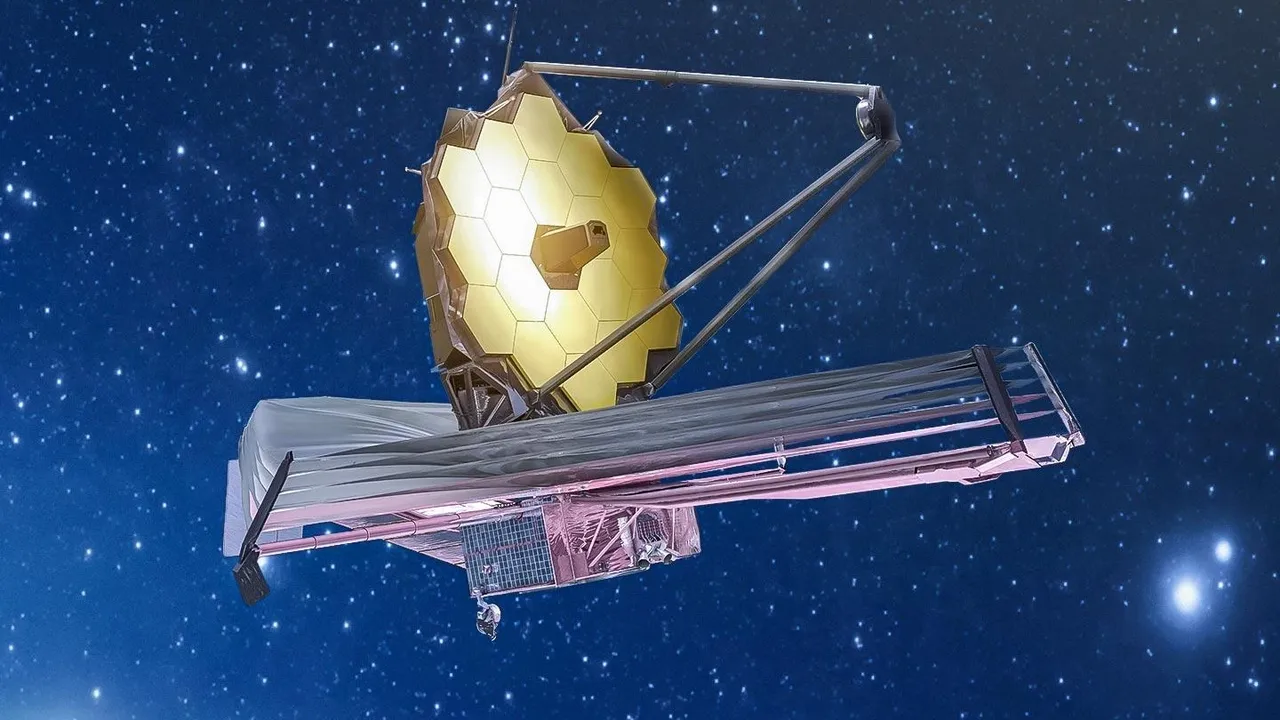
When the James Webb Space Telescope (JWST) began delivering its first images, scientists noticed a recurring anomaly: tiny, intensely red points of light scattered across the blackness of deep space. Nicknamed “Little Red Dots” (LRDs), their nature was
an immediate and compelling puzzle. Were they relatively nearby objects, their light reddened by thick clouds of cosmic dust? Or were they something far more profound—objects seen across immense cosmic distances, their light stretched to the red end of the spectrum by the expansion of the universe itself? The answer would have major implications for our understanding of the cosmos, and the race was on to identify these mysterious dots.
Webb's Decisive Gaze
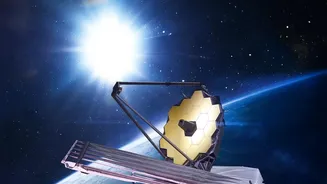
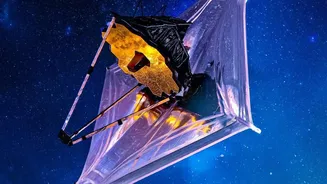
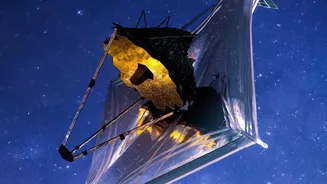
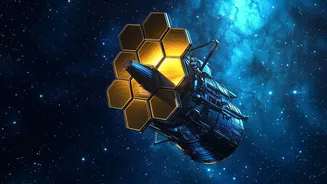
The JWST is uniquely equipped for this kind of detective work. Its unparalleled sensitivity to infrared light allows it to peer back to the dawn of time. The key technique is spectroscopy, which involves breaking an object's light into its constituent colours, like a cosmic barcode. For extremely distant objects, the universe's expansion stretches this light toward longer, redder wavelengths in a phenomenon known as redshift. A higher redshift means a greater distance and an earlier point in cosmic history. By applying this method to the LRDs, researchers could definitively measure their distance and, in doing so, determine if they were part of the infant universe.
The Verdict: Monsters in the Dawn of Time
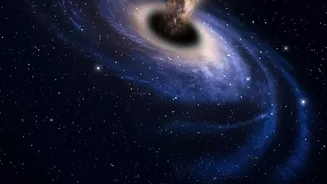
A cascade of recent studies has settled the debate, confirming the most exciting hypothesis. The data shows that LRDs are not local phenomena; they are located at extremely high redshifts. This places them firmly in the early universe, some existing just 500 to 800 million years after the Big Bang. But they are not just distant galaxies. The spectral data reveals that these dots are active galactic nuclei (AGNs)—super-bright galactic cores powered by ravenously feeding supermassive black holes. This confirms that these tiny dots are, in fact, some of the most powerful objects in the early cosmos, their light having travelled for over 12 billion years to reach us.
A New Kind of Cosmic Engine
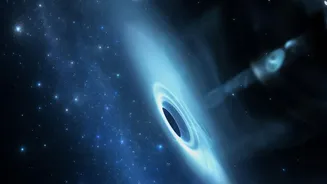
While identifying LRDs as AGNs is a major step, it also deepens the mystery. These objects don’t behave like the AGNs we see in the universe today. For example, they are surprisingly faint in X-rays and radio waves, which are usually strong signatures of a feeding black hole. The latest research suggests an explanation: these are likely young, growing supermassive black holes that are still encased in a thick, dense cocoon of gas. This gaseous shroud absorbs higher-energy radiation like X-rays and re-emits it as infrared light, explaining both their extreme redness and their unusual spectral properties. They appear to be a unique class of object specific to the conditions of the early universe.
Rewriting the First Chapter of the Universe
The existence of these objects so early in cosmic history is forcing a major rethink of how the universe’s first large structures formed. Standard theories long suggested that black holes started small, from the collapse of individual stars, and grew slowly over billions of years. However, the LRDs host black holes that are already enormous, far too large to have grown by this gradual process. This lends strong support to an alternative “heavy seed” model, where the first black holes formed from the direct collapse of immense primordial gas clouds. Some studies also suggest that the LRD phase may be a brief but crucial stage in every massive galaxy's evolution, a cosmic rite of passage before they settle into the types of galaxies we see today.