



The Myth of Heavy Weights
A common misconception is that muscle growth requires lifting heavy iron. The reality is that muscles respond to resistance, regardless of its source. Your own body weight can provide substantial resistance to challenge your muscles and stimulate growth.
The key is not the equipment, but the principle of progressive overload, which is the idea that your muscles must be continually challenged to adapt and get stronger. Studies have shown that when performed with the right intensity, bodyweight exercises can produce muscle activation comparable to traditional weightlifting. This makes at-home training a powerful and convenient alternative for building a strong, resilient physique.
Mastering the Upper Body
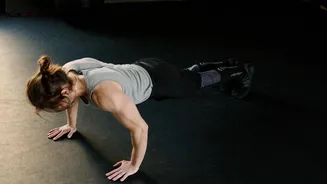
For a powerful chest, shoulders, and arms, the push-up is king. This classic exercise works multiple muscle groups at once and can be easily modified for any fitness level. Beginners can start with wall push-ups or incline push-ups on a sturdy table, while more advanced individuals can progress to decline push-ups or even one-arm variations. For your triceps, chair dips are an excellent option. Sit on the edge of a sturdy chair, place your hands beside your hips, and slide your bottom forward. Lower your body until your elbows are at a 90-degree angle, then push back up. This targets the back of your arms effectively without needing any special gear.
Building a Solid Lower Body
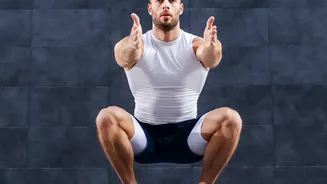
You don't need a squat rack to build strong legs and glutes. The bodyweight squat is a fundamental movement that strengthens your entire lower body. To perform it correctly, stand with your feet shoulder-width apart, keep your chest up, and lower yourself as if sitting in a chair until your thighs are parallel to the floor. Lunges are another fantastic exercise for targeting your quads, hamstrings, and glutes individually. You can do them forward, backward, or walking. For an extra glute focus, the glute bridge is simple yet powerful. Lie on your back with your knees bent, feet flat on the floor, and lift your hips toward the ceiling, squeezing your glutes at the top.
Forging a Strong, Stable Core
A strong core is the foundation of all movement, and you can build one without a single crunch. The plank is a superior exercise for core stability. Hold a push-up position, either on your hands or forearms, keeping your body in a straight line from head to heels. Challenge yourself by trying side planks to target your obliques or adding mountain climbers, where you alternate bringing your knees to your chest from a plank position. Leg raises are another effective movement. Lie on your back and slowly lift your straight legs towards the ceiling, then lower them without letting them touch the floor. This places intense focus on your lower abdominal muscles.
The Secret Ingredient: Progression
The key to continuous muscle growth with bodyweight exercises is making them progressively harder over time. Once you can comfortably perform an exercise for a certain number of repetitions, it's time to increase the challenge. You can do this in several ways: increase the number of reps or sets, slow down the movement to increase time under tension, decrease your rest time between sets, or switch to a more difficult variation of the exercise. For example, a regular squat can become a jump squat, and a standard push-up can become a diamond push-up to target the triceps more intensely. This constant adaptation is what forces your muscles to grow stronger.