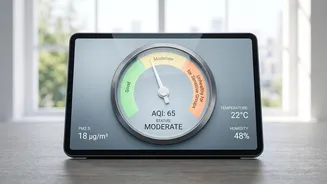







As winter arrives in Delhi, so does the familiar blanket of smog and a daily stream of Air Quality Index numbers. But what do figures like 150, 300, or 450 really mean for your health? This guide will help you decode those numbers.
What Exactly Is the AQI?
The Air Quality Index,
or AQI, is a tool used to communicate how polluted the air currently is. Instead of showing you complicated levels of different pollutants, the AQI simplifies it into a single number. India's Central Pollution Control Board (CPCB) launched the national AQI in 2014 with a clear goal: 'One Number, One Colour, One Description'. The system monitors eight major pollutants, including PM2.5 and PM10 (tiny, harmful particles), Nitrogen Dioxide, and Carbon Monoxide. The final AQI number you see is determined by the pollutant with the highest concentration at that moment, ensuring the index reflects the most immediate health risk.
Good (0-50) & Satisfactory (51-100)
When the AQI is in the 'Good' (green) range, air quality is considered safe with minimal health impact. You can comfortably enjoy outdoor activities. In the 'Satisfactory' (light green) range, the air is still broadly acceptable. However, a small number of unusually sensitive people might experience minor breathing discomfort. For most of the population, there is no cause for concern at this level, and daily life can proceed as normal.
Moderate (101-200)
An AQI in the 'Moderate' (yellow) category is where vulnerable groups need to start paying attention. While the general public is not likely to be affected, people with existing lung conditions like asthma, heart disease, as well as children and older adults, may experience breathing discomfort. Health authorities advise that these sensitive groups should reduce prolonged or heavy exertion outdoors. It's a good time to consider wearing an N95 mask if you fall into one of these categories and need to be outside for an extended period.
Poor (201-300)
Once the AQI crosses 200 and enters the 'Poor' (orange) zone, the health impacts become more widespread. At this level, most people may begin to experience some breathing discomfort, especially during prolonged exposure. The risk for people with heart or lung disease increases, and they are advised to avoid extended outdoor activities. For everyone, this is a clear signal to reduce heavy physical exertion outdoors, such as jogging or sports. Using an air purifier indoors can help create a safer environment at home.
Very Poor (301–400)
A 'Very Poor' (red) reading is a health alert. Prolonged exposure can lead to respiratory illness even in healthy individuals. The impact on those with existing heart or lung conditions becomes more severe. At this stage, it is strongly recommended for everyone to avoid and limit outdoor physical activity, particularly during the early morning and evening when pollution levels are often at their highest. Staying indoors as much as possible is the best course of action. If you must go out, a certified N95 or N99 mask is essential for protection.
Severe (401–500+)
The 'Severe' (maroon) category signifies emergency conditions. The air quality is considered hazardous and is likely to affect the entire population. Even healthy people can experience respiratory symptoms, and the health impacts may be felt even during light physical activity. For those with existing diseases, the situation is particularly dangerous. Authorities advise everyone to avoid all outdoor physical activity. Remaining indoors with windows closed and using air purifiers is critical to minimise exposure to the toxic air.