

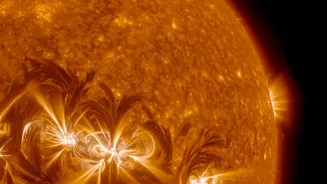
The Invisible Threat from the Sun
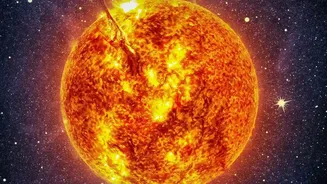
Our modern world runs on electricity and data. From power grids and GPS navigation to global banking and communications, a complex web of technology underpins daily life. But this intricate system has a celestial vulnerability: the sun. Solar storms,
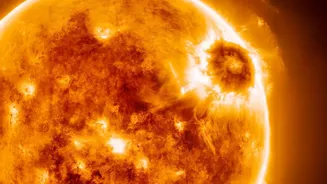
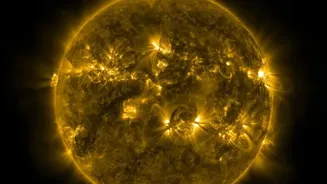
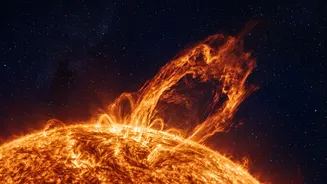
specifically Coronal Mass Ejections (CMEs), are massive explosions on the sun's surface that hurl billions of tons of charged particles into space. If Earth is in the crosshairs, the consequences can be severe. These geomagnetic storms can induce powerful electrical currents in our power lines, potentially overloading transformers and causing widespread, long-lasting blackouts. They can also damage sensitive satellite electronics, disrupting communication and navigation services we take for granted. The most famous example, the 1859 Carrington Event, fried telegraph systems worldwide; a similar event today would be catastrophically disruptive to our digital society.
The Challenge of a Speedy Forecast
For decades, predicting the specific, localized impact of a solar storm has been a significant challenge. Scientists can observe a CME leaving the sun, but knowing exactly how and where it will affect Earth's magnetic field upon arrival is a different problem. Current methods often involve human analysts studying data from satellites positioned between the Earth and the sun. While these methods can provide a general warning that a storm is coming, they often lack the speed and specificity needed for targeted, preventative action. Previous models were either localized to specific areas or provided global predictions that weren't timely enough to be truly useful. This left infrastructure operators with a difficult choice: take costly and disruptive preventative measures for every potential threat, or risk being caught unprepared by a major event.
Enter DAGGER: An AI Shield
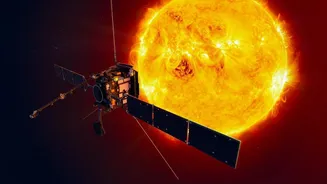
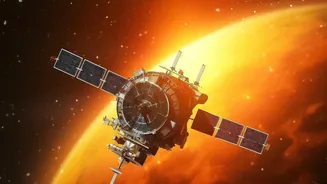
This is where a new artificial intelligence system changes the equation. Developed through a collaboration including NASA and the Frontier Development Lab, the model is called DAGGER, which stands for Deep Learning Geomagnetic Perturbation. Unlike previous systems, DAGGER uses the power of AI to analyze vast amounts of data in real-time. It studies live measurements of the solar wind—the stream of particles constantly flowing from the sun—from various spacecraft and connects that data to geomagnetic disturbances measured on the ground. By training on historical data from past solar storms, the AI has learned to identify the subtle patterns that precede a geomagnetic disturbance on Earth. The result is a system that can produce rapid, precise, and global forecasts.
From Hours of Uncertainty to Minutes of Clarity
The single most significant breakthrough offered by DAGGER is its speed and precision. The AI model can generate a specific, localized prediction for anywhere on Earth about 30 minutes before a solar storm hits. This 30-minute lead time is possible because the data from satellites travels at the speed of light, while the plasma from the solar storm travels much slower. Furthermore, the AI can generate these predictions in less than a second and update them every single minute. This represents a monumental leap from older models that could take much longer to run their calculations, often rendering their warnings too late to be actionable. DAGGER is the first model to combine the swift analysis of AI with real-time measurements to produce forecasts that are both prompt and globally precise.
What a 30-Minute Warning Buys Us
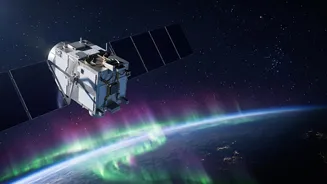
While 30 minutes may not sound like much, in the context of infrastructure protection, it is a transformative amount of time. For power grid operators, this advance warning is enough to reroute power, take sensitive transformers offline, and prepare for potential surges, helping to prevent a cascading failure and widespread blackouts. Satellite controllers can use this time to place their multi-million dollar assets into a protective 'safe mode' or even slightly alter their orbits to minimize damage. Airlines can reroute flights that would otherwise travel over the poles, where the effects of space weather are strongest. By making the code open source, the developers have enabled any company or agency to adapt the tool for its specific needs. This warning system shifts the posture from one of passive vulnerability to one of active, targeted defense.