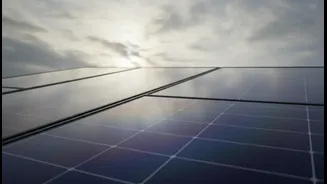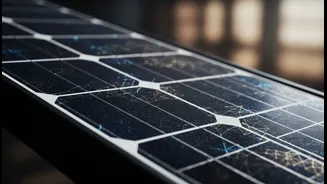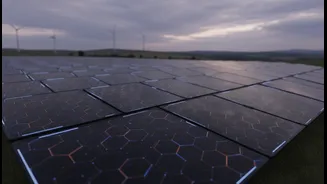










The Overcast Challenge
Conventional solar power, based on crystalline silicon photovoltaic (PV) cells, has a straightforward relationship with the sun: the more direct sunlight, the more power it generates. This has driven India’s incredible solar expansion, primarily in sun-drenched
regions. However, this strength is also a weakness. On heavily overcast days, or during the prolonged monsoon season, the output of traditional solar farms can drop significantly, producing just 10-25% of their rated capacity. This intermittency is a major headache for grid managers, who must have fossil-fuel-based power plants on standby to ensure a stable supply, undermining the very goal of clean energy.
A Breakthrough in the Clouds
Enter the next generation of solar technology. Researchers are making significant strides with materials that are far more effective in low-light conditions. The most prominent among these are perovskite solar cells (PSCs). Unlike rigid silicon panels, perovskites use a specific crystal structure that is exceptionally good at absorbing diffuse light—the kind that filters through clouds. While traditional panels are optimised for the intense energy of direct sunlight, these new materials can be tuned to capture a wider spectrum of light, making them uniquely suited for grey, overcast days and even indoor ambient light.
How This New Tech Works
The magic of perovskite cells lies in their material properties and structure. They have what's known as a high absorption coefficient, meaning a very thin layer of the material can capture a great deal of light. Furthermore, their electronic properties allow them to generate a relatively high voltage even when the light intensity is low. Some of the most promising applications involve creating 'tandem' cells, where a thin, semi-transparent layer of perovskite is placed on top of a traditional silicon cell. The perovskite layer captures high-energy blue light, while the silicon layer below captures the lower-energy red and infrared light that passes through, boosting overall efficiency in all conditions.
Reshaping India's Energy Future
For India, this technology is more than just a scientific curiosity; it's a potential game-changer. Consistent energy generation, even during the four-month monsoon, would dramatically improve grid stability and reduce the reliance on coal-fired 'peaker' plants. It would make solar power a viable, year-round solution for states in the North-East and other regions that experience significant cloud cover. This enhanced reliability could accelerate India’s push towards its ambitious goal of 500 GW of renewable capacity by 2030 and net-zero emissions by 2070. By providing more predictable power, these panels support a more decentralized and resilient grid, empowering local communities and reducing transmission losses.
Hurdles on the Horizon
Despite the immense promise, a future powered by all-weather solar panels is not yet guaranteed. The biggest challenges for perovskite technology are durability and scalability. Early versions of these cells tended to degrade when exposed to moisture and oxygen, a significant concern in a humid country like India. While recent advances have improved stability, researchers are still working to ensure these panels can last for 25-30 years like their silicon counterparts. Furthermore, scaling up manufacturing from the laboratory to industrial production while keeping costs low is a major obstacle that companies are actively working to solve.