


The Technique: Transmission Spectroscopy
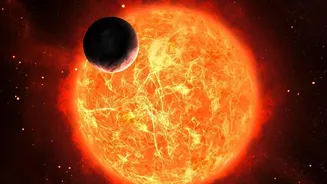
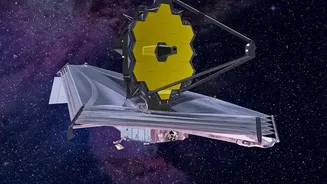
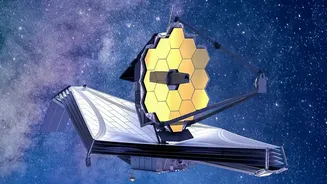
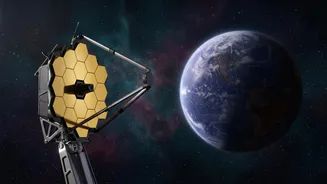
The primary method JWST uses is called transmission spectroscopy. Imagine an exoplanet passing in front of its host star from our point of view—an event known as a 'transit'. For a brief period, the starlight has to travel through the planet’s atmosphere
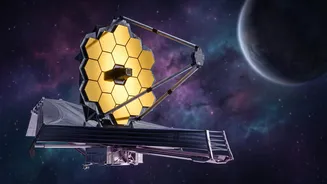
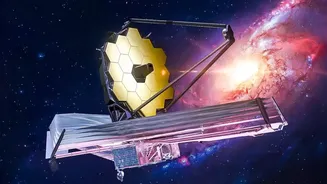
before it reaches Webb’s giant mirrors. This is the crucial moment. While most of the star’s light is blocked by the planet itself, a tiny sliver is filtered through its atmospheric layer. By capturing this light, astronomers can hunt for the chemical fingerprints left behind.
Why Infrared Vision is Key
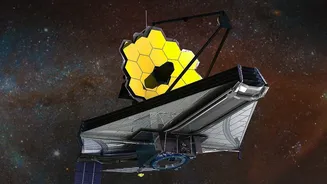
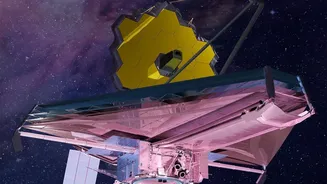
JWST is designed specifically to see the universe in infrared light, which is invisible to the human eye. This capability is essential for studying exoplanets. Many molecules that are key to understanding a planet's environment—like water, methane, and carbon dioxide—absorb light most strongly at infrared wavelengths. Earth’s own atmosphere blocks most of this light, which is why a space-based observatory like Webb is so revolutionary. From its vantage point one million miles from Earth, it can capture a much broader and more detailed range of this infrared information than telescopes on the ground.
Webb's Specialist Tools
To perform this cosmic analysis, the telescope relies on a suite of powerful instruments called spectrographs. The main ones used for exoplanet atmospheres are the Near-Infrared Spectrograph (NIRSpec), the Near-Infrared Imager and Slitless Spectrograph (NIRISS), and the Mid-Infrared Instrument (MIRI). These instruments act like high-tech prisms, splitting the incoming starlight into a rainbow-like spectrum. NIRSpec and NIRISS cover the near-infrared range (0.6 to 5.3 microns), while MIRI extends the view into the mid-infrared (5 to 28 microns), allowing scientists to detect an even wider array of molecular signatures.
Decoding the Chemical Barcode
When the starlight passes through the exoplanet's atmosphere, different molecules absorb very specific wavelengths, or 'colors', of that light. This creates a unique pattern of dark lines or dips in the spectrum, which scientists can read like a chemical barcode. For example, a dip at a particular infrared wavelength indicates the presence of water vapor, while another signifies carbon dioxide. Before the planet transits, Webb measures the pure, unfiltered light from the star. It measures again during the transit. By subtracting the first measurement from the second, astronomers are left with only the light that passed through the atmosphere and the chemical information it holds.
From Data to Discovery
This process has already yielded groundbreaking results. Using its infrared sensors, Webb provided the first clear detection of carbon dioxide in an exoplanet's atmosphere on a gas giant named WASP-39 b. For the same planet, it also made the first-ever detection of sulfur dioxide, which suggests active chemical reactions—known as photochemistry—are occurring due to the intense light from its star. On another world, K2-18 b, a potential 'Hycean' (hot and ocean-covered) planet, Webb detected methane and carbon dioxide, crucial ingredients in the search for habitable environments. It has even detected quartz nanocrystals in the clouds of a 'hot Jupiter' called WASP-17 b, essentially identifying alien weather patterns. These discoveries, made by decoding light from trillions of kilometres away, are transforming our understanding of planets beyond our solar system.