

An Archive Made of Ice
In places like Antarctica and Greenland, snow that falls rarely melts. Over centuries, layers of snow build upon each other, and the immense weight compresses the lower layers into solid ice. This process creates an incredible natural archive. Each layer of ice corresponds
to a specific period, much like the rings of a tree. By drilling deep and extracting long cylinders of ice, known as ice cores, scientists can physically hold a piece of the past, sometimes dating back as far as 800,000 years.
Bubbles of Prehistoric Air
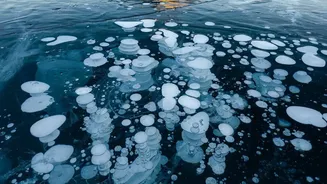
As the snow gets compressed, the air between the snowflakes gets trapped, forming minuscule bubbles. These bubbles are perfect, tiny time capsules, preserving a sample of the atmosphere from the moment they were sealed. In specialized labs, scientists carefully melt the ice in a vacuum to release this ancient air. By analyzing its composition, they can directly measure the concentrations of past greenhouse gases, including carbon dioxide and, crucially, methane. This gives us a direct record of what our planet's atmosphere was like long before human monitoring began.
Methane: The Wetland Fingerprint
Methane is a powerful greenhouse gas, and in the pre-industrial world, its primary natural source was wetlands. These water-logged environments, from tropical swamps to northern peatlands, are filled with microbes that break down organic matter, releasing methane in the process. Therefore, a spike in atmospheric methane recorded in an ice core strongly suggests a period when Earth's wetlands were expanding or becoming more productive. In essence, the global methane level acts as a proxy, or an indirect indicator, for the total extent of wetlands on the planet at a given time.
Decoding the Message in Methane
But how can scientists be sure the methane came from wetlands and not another source, like wildfires or geologic seeps? The answer lies in isotopic analysis. By studying the different types of carbon atoms (isotopes) within the methane molecules, researchers can identify their origin. For example, methane produced by the biological processes in wetlands has a different isotopic signature than methane released from melting permafrost or fossil fuel deposits. This chemical fingerprinting allows them to distinguish between sources and confirm that shifts in methane during past warm periods were driven by changes in wetland ecosystems, not catastrophic releases from other reservoirs.
Painting a Picture of the Past
By combining methane data from ice cores in both Greenland and Antarctica, scientists can even deduce the general location of these ancient wetlands. Because methane has a relatively short lifespan in the atmosphere, higher concentrations in Northern Hemisphere ice cores (from Greenland) compared to the Southern Hemisphere (Antarctica) point to major wetland expansion in the northern tropics or high latitudes. Studies have used this method to show that past warming events, such as the one around 11,600 years ago, were accompanied by a significant expansion of wetlands, likely in tropical regions.
Why Ancient Wetlands Matter Today
Understanding this history is not just an academic exercise; it's vital for our future. It provides a baseline for Earth's natural methane cycle, helping us to more accurately quantify the impact of human-caused emissions from agriculture and fossil fuels today. For a nation like India, which faces significant climate challenges, comprehending these natural cycles is crucial for creating more accurate climate models. These models inform policies on everything from water resource management to protecting vulnerable coastal communities. By looking into the past, we gain invaluable context for the unprecedented atmospheric changes happening now and can better prepare for the future.