




What Is This Celestial Glow?
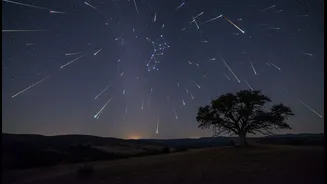
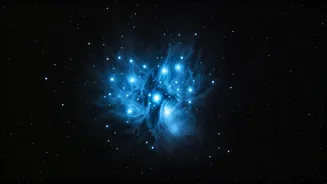
The celestial spectacle in question is the Pleiades star cluster, one of the most famous and beautiful deep-sky objects visible to the naked eye. Known in India as Krittika, and in the West as the Seven Sisters, it’s not a single star but a family of over
1,000 young, hot, blue stars gravitationally bound together. From Earth, it often looks like a tiny, shimmering question mark or a miniature dipper hanging in the sky. To the unaided eye, most people can spot six or seven of its brightest stars, but the entire cluster is enveloped in a faint, ethereal haze—a cosmic cloud of dust that reflects the brilliant blue light of the stars within it. This is the “dazzling sky glow” making its grand arrival.
A 444-Year Journey Through Time
Here's where the story gets truly mind-bending. The Pleiades cluster is approximately 444 light-years away from us. A light-year is the distance light travels in one year—a staggering 9.46 trillion kilometres. This means the light you see when you look at the Pleiades tonight started its journey around the year 1580. Think about that. When these photons began their epic voyage across the cosmos, the Mughal emperor Akbar was ruling over much of the Indian subcontinent. The first British traders had only just begun to explore sea routes to India. The world was a vastly different place. What you are seeing is not the Pleiades as it is right now, but as it was more than four centuries ago. You are literally looking into the past.
The Science Behind the Sparkle
The stars of the Pleiades are cosmic newborns, having formed only about 100 million years ago. For comparison, our Sun is 4.6 billion years old. These young stars are incredibly hot and luminous, burning with a fierce blue-white intensity. The faint nebulosity, or dust cloud, that surrounds them was once thought to be leftover material from their formation. However, astronomers now believe the cluster is simply passing through an unrelated cloud of interstellar dust in space. This dust acts like a fog bank in front of a car’s headlights, scattering the blue light from the hot stars and creating the delicate, ghostly glow that makes the Pleiades so breathtakingly beautiful in photographs and through telescopes.
How to Find It in the Indian Sky
Finding Krittika is relatively easy, even for novice stargazers. During the winter and spring months, it’s high in the evening sky. Look for the constellation Taurus, the Bull, which is easily identified by its V-shaped face and the bright reddish star Aldebaran (Rohini). The Pleiades cluster rides on the “shoulder” of the Bull. The best way to view it is to get away from bright city lights. Let your eyes adjust to the darkness for about 15-20 minutes. At first, it might just look like a blurry smudge. Use your peripheral vision; looking slightly away from it can sometimes make it pop into view more clearly. If you have a pair of binoculars, you’re in for a treat. Binoculars will resolve the misty patch into dozens of individual, glittering stars, transforming a faint glow into a spectacular celestial jewel box.
A Star Cluster Steeped in Culture
The Pleiades holds a special place not just in astronomy but in cultures around the world, including in India. In Hindu mythology, the Krittikas are the six mothers who raised the war god Kartikeya. The cluster’s rising and setting have been used for millennia to mark seasons and festivals. For example, the festival of Karthigai Deepam, celebrated in Tamil Nadu and other southern states, is timed with the full moon in alignment with the Krittika nakshatra. Seeing it is more than just a science lesson; it’s a connection to an ancient heritage of sky-watching that has been woven into the fabric of our culture for thousands of years.