





The Brain’s Unsung Hero
Often called the 'little brain', the cerebellum is a densely packed structure located at the back of your skull. While it only accounts for about 10% of the brain's total volume, it contains over half of all its neurons. For centuries, scientists knew
it was crucial for motor control, responsible for the smooth, coordinated movements we take for granted—from walking and writing to playing a musical instrument. Its primary job has been understood as an 'error corrector'. It constantly compares your brain's intended actions with the actual sensory feedback from your body. If there's a mismatch, like your foot landing lower than expected, the cerebellum instantly sends out corrective signals to your muscles to prevent a fall.
A Deeper Look at the Circuitry
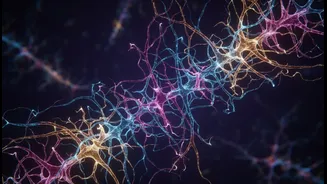
To perform these incredible feats of computation, the cerebellum relies on a highly organized internal circuit. The traditional understanding involved two main types of input fibres. Mossy fibres carry a vast amount of information from your body and cerebral cortex about your position, speed, and planned movements. Climbing fibres send powerful signals that are thought to be related to learning from errors. These inputs are processed by a network of neurons, most notably the tiny but incredibly numerous granule cells and the large, elaborate Purkinje cells, which are the sole output of the cerebellar cortex. For a long time, this was the accepted blueprint for how the cerebellum fine-tunes our actions. But a deeper dive has revealed a more complex and efficient system.
The 'Amplifier' in the Machine
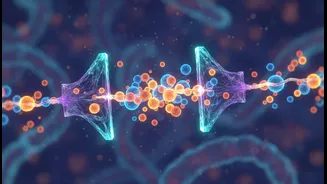
Recent investigations have shed more light on a special type of neuron that dramatically changes the game: the unipolar brush cell, or UBC. Found in the cerebellum's input layer, the UBC acts as a powerful signal amplifier. Unlike a granule cell, which samples from several input fibres, a single UBC receives a dedicated, powerful connection from just one mossy fibre. What it does next is remarkable. Upon receiving that signal, the UBC doesn't just pass it on; it generates a prolonged burst of activity, effectively amplifying the original message and broadcasting it to hundreds of surrounding granule cells. This micro-circuit creates a powerful feed-forward loop, ensuring that a single important signal isn't lost in the noise but is instead boosted for maximum impact.
Coordinating the Split-Second Save
This UBC-driven micro-circuit is the key to how we make successful, rapid reflex adjustments. When you slip, the sensory information about that unexpected movement rushes to the cerebellum via mossy fibres. When this signal hits a UBC, it's immediately amplified. This ensures the 'emergency' alert is spread quickly and strongly through the granule cell layer, leading to a robust and immediate response from the Purkinje cells. Research has even identified different subtypes of UBCs, including 'ON' cells that increase their activity and 'OFF' cells that decrease it, in response to different sensory inputs. This allows for an incredibly sophisticated level of fine-tuning, enabling the cerebellum to precisely manage which muscle groups to activate and which to relax, all within milliseconds. It’s the difference between a clumsy stumble and a graceful recovery.
From Movement to Mind
The importance of understanding these intricate circuits extends far beyond just motor control. Scientists are increasingly realizing the cerebellum contributes to a wide range of non-motor functions, including language, emotional regulation, and cognitive processing. Consequently, dysfunction in these cerebellar circuits is being linked to a variety of conditions, not just movement disorders like ataxia and tremors, but also developmental disorders such as autism. By untangling the precise wiring and function of micro-circuits involving unipolar brush cells and their partners, researchers hope to gain new insights into what goes wrong in these conditions. This fundamental knowledge could one day pave the way for more targeted therapies to help restore function to the brain's master coordinator.