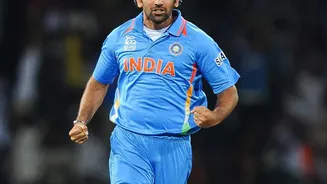





When India lifted the 2011 World Cup, it was on the back of several heroic efforts. But the most calculated, game-changing contribution came from its pace spearhead, Zaheer Khan, who was a completely different bowler from years prior.
The Ghost of World Cups Past
To understand the
master that Zaheer Khan became, one must first remember the bowler he was. His career before the late 2000s was a story of immense talent hampered by inconsistency and frequent injuries. The lowest point came in the 2003 World Cup final. A nervy Zaheer sprayed the ball, conceding 15 runs in his first over and setting the stage for an Australian onslaught. He finished with forgettable figures, a symbol of a talented but raw bowler cracking under pressure. For years, Zaheer was a potent force but also a frustrating one, prone to breaking down and losing his rhythm. After being dropped from the team around 2005-06, his international career was at a crossroads.
The Worcestershire Stint That Changed Everything
The turning point came not in an Indian jersey, but in the English county circuit. In 2006, Zaheer signed with Worcestershire, a decision that would fundamentally alter his career trajectory. Away from the intense pressure of international cricket, he rediscovered his love for bowling. Working with bowling coach Graham Dilley, he made critical technical adjustments. He shortened his run-up, making it more explosive and efficient, and improved his balance at the crease. This stint was about more than just mechanics; it was a mental reset. He bowled long spells, took 78 wickets, and learned to think his way through an innings, setting up batsmen and controlling the game's tempo. He returned to the Indian side not just as a bowler, but as a strategist.
The Knuckleball and The Art of Deception
Armed with a renewed mind and body, Zaheer added a new weapon to his arsenal: the knuckleball. He reportedly learned the delivery from South African pacer Charl Langeveldt and perfected it in the lead-up to the World Cup. In an era before it became a T20 staple, Zaheer’s use of the knuckleball was revolutionary. It wasn’t just a slower ball; it was a piece of theatre. Delivered with an identical arm speed to his stock delivery, the ball would arrive dramatically slower, dipping on the batsman and completely disrupting their timing. He used it to great effect during the World Cup, famously dismissing key players like Ian Bell, Paul Collingwood, and Michael Hussey with it. This single delivery epitomised the new Zaheer: smarter, more deceptive, and always one step ahead.
The 'Bowling Captain' Under Dhoni
By 2011, Zaheer’s transformation was complete. Under MS Dhoni's captaincy, he evolved into the undisputed leader of the pace attack—a 'bowling captain'. He was the on-field general for the bowlers, thinking about field placements, mentoring the younger pacers, and identifying opposition weaknesses. Then-coach Gary Kirsten lauded him as an 'intellect on the game' who was brilliant at exploiting batsmen's flaws. His role was threefold: strike with the new ball, control the middle overs with cutters and seam movement, and master the art of reverse swing with the old ball. This versatility made him India's go-to bowler in any situation. His opening spell in the 2011 final was the perfect redemption: three maidens, a wicket, and only six runs conceded in his first five overs, exorcising the ghosts of 2003 for good.