


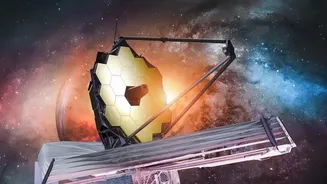
A Glimpse into Alien Atmospheres
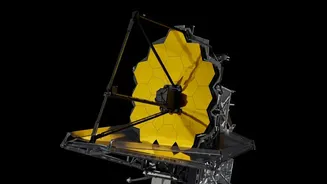
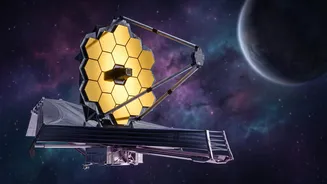
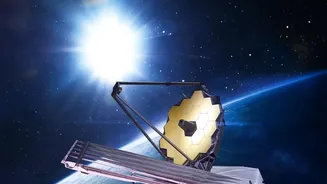
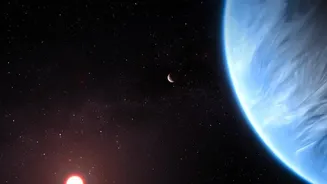
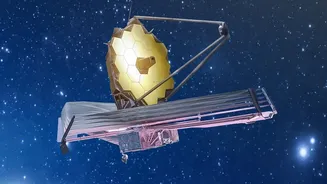
In a series of groundbreaking observations, astronomers have used the powerful infrared instruments aboard the JWST to study the atmospheres of 'super-Earths'—planets larger than our own but smaller than Neptune. One such world, GJ 486 b, located 26 light-years
away, has shown intriguing hints of water vapour. Another, the scorching-hot 55 Cancri e, may possess a substantial atmosphere rich in volatiles like carbon dioxide that likely bubbled out of a planetary magma ocean. While these findings don't point to lush, water-covered worlds, they represent a monumental achievement. Detecting any kind of atmosphere around a rocky planet is a huge technological leap, proving that Webb is capable of peering into the skies of worlds far beyond our solar system.
What Exactly Are Super-Earths?
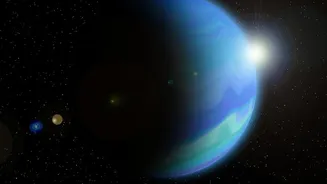
Super-Earths are one of the most common types of planets in our galaxy, yet strangely, our own solar system doesn't have one. These worlds occupy a fascinating middle ground: they are more massive and larger than Earth but not as large as ice giants like Neptune or Uranus. This size category means they could be rocky like Earth or have a dense, gassy envelope, making them prime targets in the search for varied planetary environments. Planets like 55 Cancri e, for instance, are about twice Earth's diameter but nearly nine times its mass. Studying them helps scientists understand the vast diversity of planets that exist and how different planetary systems form and evolve.
Webb’s Extraordinary Vision
So how does Webb see an atmosphere from light-years away? It uses a technique called transmission spectroscopy. When an exoplanet passes in front of its host star from our perspective, a tiny fraction of the starlight filters through the planet's atmosphere. Webb’s sensitive infrared instruments, the Near-Infrared Spectrograph (NIRSpec) and the Mid-Infrared Instrument (MIRI), analyse this filtered light. Different molecules in the atmosphere absorb specific wavelengths of light, leaving a unique chemical fingerprint. By studying which colours of light are missing, astronomers can deduce what gases are present. It was through this method that the potential signature of water vapour on GJ 486 b was identified.
Water Vapour, Not Water Worlds
It’s crucial to place these discoveries in context. Finding water vapour does not mean we've found oceans or life. The planets in question are often extremely hot; 55 Cancri e has surface temperatures hot enough to melt rock, and GJ 486 b is a scorching 430 degrees Celsius. Any water would exist as steam in a crushing, inhospitable atmosphere. Furthermore, scientists are carefully working to confirm that the water signature is genuinely from the planet and not from cool spots on its host star, which can also contain water vapour and mimic a planetary atmosphere. The primary excitement, therefore, comes from proving the method. We now know JWST can find these signatures, paving the way to study more temperate, Earth-like planets in the future.
The Search for Habitable Worlds Continues
These findings are not the destination, but a critical signpost on the journey. By successfully detecting atmospheric components around challenging targets like rocky super-Earths, scientists have validated one of JWST's key mission goals. The telescope can now be aimed at planets that orbit within their star's 'habitable zone'—the region where temperatures could allow liquid water to exist on a planet's surface. The ultimate goal is to find a rocky planet with an atmosphere containing biosignatures: a cocktail of gases like oxygen, methane, and water vapour that could indicate the presence of life. This recent success is a foundational step, demonstrating that we finally have the right tool to begin answering one of humanity’s oldest questions: are we alone?