



The Sweet Problem of Life's Beginning
Before life, there was chemistry. To get from a barren, rocky planet to the first living cells, a series of chemical reactions had to produce the essential building blocks: amino acids for proteins, nucleobases and sugars for RNA and DNA. For decades,
scientists have had plausible theories for most of these ingredients, but sugars have remained a stubborn puzzle. Sugars like ribose form the backbone of our genetic material, yet they are incredibly fragile. The leading theory for their formation, known as the 'formose reaction,' involves simple formaldehyde molecules linking together. The problem? The reaction is notoriously messy. Instead of producing a clean supply of useful sugars, it creates a complex, tar-like gunk with only trace amounts of the right stuff. This 'tar problem' has been a significant weak link in our understanding of prebiotic chemistry, leaving a crucial question unanswered: if life needs sugars, but making them on early Earth was so difficult, where did they come from?
A Discovery from Deep Space
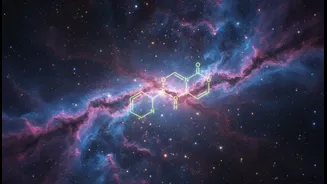
Now, an international team of scientists has found a compelling clue, not on Earth, but thousands of light-years away in the heart of the Milky Way. Using the powerful Yebes and IRAM radio telescopes in Spain, astronomers detected the distinct chemical signature of a complex sugar called erythrulose. The discovery was made in a vast, dense cloud of gas and dust known as G+0.693-0.027, a known nursery for complex molecules. This marks the first time a true sugar has been definitively identified in interstellar space. While sugars have been found in meteorites that have landed on Earth before, finding one floating freely in the cosmic cloud from which stars and planets are born is a landmark achievement. It suggests that this essential ingredient for life isn't something that had to be cooked up in Earth’s primordial soup; it was already on the cosmic menu.
From Simple Molecules to Cosmic Sugar
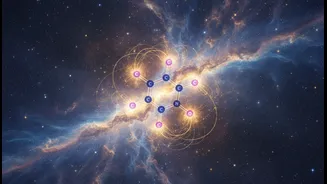
Erythrulose, a four-carbon sugar also found in raspberries, appears to have formed under the extreme conditions of deep space. The researchers propose that its formation didn't follow the messy formose pathway. Instead, it likely assembled on the surface of icy dust grains, where simpler two-carbon molecules like alcohols and aldehydes could merge. This cosmic chemistry is more efficient and direct, building a larger, more complex sugar without degrading into tar. This finding challenges previous theories that complex molecules build up slowly, one carbon atom at a time. The detection proves that surprisingly sophisticated molecules, which are vital for biology, can arise naturally in the cold, sparse environment between stars, long before planets even exist to host them. This suggests the universe is seeded with the raw materials for life far more widely than we previously knew.
A Sweet Delivery to Early Earth
The discovery of erythrulose in space provides a powerful solution to the sugar problem. The theory is that this sugar, and others like it, could have been delivered to a young Earth during periods of heavy bombardment by asteroids and comets billions of years ago. Researchers estimate that millions of tonnes of erythrulose could have rained down on our planet, stocking the prebiotic chemical inventory. While erythrulose is not the sugar found in RNA or DNA, it is a highly significant precursor. In water, it can readily transform into other biologically important sugars that are thought to be key steps on the path to life. For example, it could have been involved in forming Threose Nucleic Acid (TNA), a proposed simpler ancestor to RNA that may have been part of the earliest genetic systems. This discovery bridges the gap between simple interstellar chemistry and the complex molecules needed to kickstart biology.