
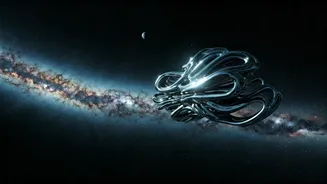


A Visitor From Deep Space
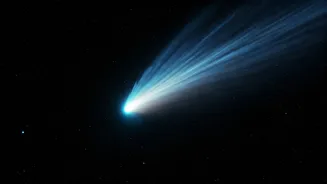
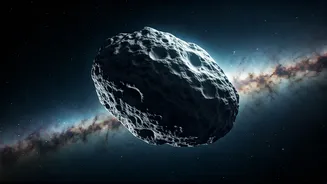
In late 2022, astronomers using the Asteroid Terrestrial-impact Last Alert System (ATLAS) in South Africa spotted a faint object hurtling towards our sun. Designated 3I/ATLAS, it was only the third interstellar object (ISO) ever detected passing through
our solar system, after the famous 'Oumuamua and Borisov. These objects are invaluable, offering us a rare glimpse into the building blocks of planetary systems far beyond our own. Unlike objects born in our solar system, which orbit the Sun, ISOs are on a one-way trip, arriving from and returning to the vast expanse of interstellar space. They are, in essence, messengers from other star systems.
The Comet That Wasn't a Comet
As 3I/ATLAS neared the Sun, it began to do something strange. It accelerated. This phenomenon, known as non-gravitational acceleration, is common for comets. As a comet warms up, its ice turns directly into gas (a process called sublimation), which jets out and acts like a tiny rocket engine, pushing the comet along faster than gravity alone can explain. The problem was, 3I/ATLAS had no visible tail. Normally, this outgassing process kicks up dust and debris, creating the spectacular coma and tail we associate with comets. But 3I/ATLAS was accelerating stealthily, without any of the usual visual cues. It was acting like a comet but didn't look like one. This was the central mystery that stumped the scientific community.
A Trail of Cosmic Breadcrumbs
The puzzle deepened when, in early 2023, the object didn't survive its close approach to the Sun. The intense solar heat and radiation caused 3I/ATLAS to break apart into smaller fragments. While this meant the end of the object itself, it provided a crucial breakthrough. By studying the trajectory of the main fragment and the pieces that broke off, astronomers could precisely measure its acceleration. The data confirmed the object was indeed being pushed by a mysterious, invisible force. The disintegration wasn't a failure but a gift, giving scientists the clues they needed to reverse-engineer the object's composition and behaviour.
The Hydrogen Engine Hypothesis
A new study, led by Qicheng Zhang of the California Institute of Technology, provides the answer. The team proposes that 3I/ATLAS was powered by a hydrogen engine. Over the millions or even billions of years it spent travelling through interstellar space, the object's water ice was constantly bombarded by high-energy cosmic rays. This process, called radiolysis, would have slowly broken down the water (H₂O) into hydrogen and oxygen. The hydrogen gas would have been trapped within the comet's icy structure. As 3I/ATLAS approached our Sun, the gentle heat was enough to release this trapped hydrogen gas. Hydrogen is extremely light, so it wouldn't have been able to lift heavier dust particles to form a visible tail. Yet, the outflow of this gas was enough to create the tiny but measurable thrust that caused the object to accelerate. It was a ghost engine, running on fuel brewed in deep space.
Why This Discovery Matters
Solving the mystery of 3I/ATLAS does more than just explain one weird space rock. It gives us a new model for understanding the composition of the smallest and most primordial comets, both in our solar system and in others. This hydrogen-releasing mechanism likely applies to many small comets, but we've never been able to detect it before because their acceleration is too tiny to measure. Because 3I/ATLAS was a pristine sample from another star system, it suggests that countless 'baby comets' across the galaxy may be built this way. It's a testament to how materials are formed and evolve in the cold, dark void between stars. Each interstellar visitor refines our understanding of how planetary systems, including our own, come into being.