





Not Just Two Superpowers Anymore
For decades, space was a two-horse race between the United States and the Soviet Union. That era is definitively over. The 21st-century version of the space race is a multipolar contest. While the US and a rapidly advancing China are the main rivals,
they are far from the only players. India, with its cost-effective missions, has emerged as a major spacefaring nation. The United Arab Emirates, Japan, and the European Space Agency are also pursuing ambitious programs, from lunar exploration to satellite technology. This diversification of players means more innovation and more missions, but it also creates a more complex and contested environment. Geopolitical tensions on Earth are increasingly extending into orbit, as nations view space capabilities as critical for economic and military advantage.
The Billionaire Effect: Private Companies Join In
Perhaps the biggest change in this new era is the rise of the private sector. Companies like SpaceX, Blue Origin, and Virgin Galactic are no longer just contractors for government agencies; they are driving innovation and launching more rockets than many countries. The development of reusable rockets has dramatically lowered launch costs, opening up space for commercial ventures that were once unthinkable. This has led to a boom in the 'new space economy,' with projections suggesting its value could surpass $1.8 trillion by 2035. This commercial gold rush includes everything from satellite internet constellations and Earth observation services to space tourism and plans for future private space stations. This public-private dynamic is transforming space from a domain of national prestige to a vibrant, and sometimes chaotic, commercial marketplace.
The Moon: A New Strategic Frontier
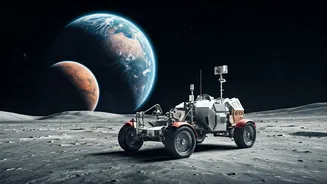
After being ignored for decades, the Moon is once again the hottest destination in the solar system. But this time, the goal isn't just to plant flags and leave footprints; it's about establishing a permanent presence. The primary driver is the discovery of water ice at the lunar south pole, a resource that can be converted into breathable air, drinking water, and, most importantly, rocket fuel. This makes the Moon a potential refueling station and a strategic gateway for more ambitious missions to Mars and beyond. This has led to two competing visions. The US-led Artemis Accords, which India has signed, brings together a coalition of nations to collaborate on lunar exploration. Meanwhile, China and Russia are leading the development of a rival International Lunar Research Station (ILRS). The race is on to secure the most resource-rich locations, which could set precedents for who benefits from the Moon's resources.
India’s Moment in the Cosmos
Amidst this global competition, India has carved out a unique and powerful position. With the historic landing of Chandrayaan-3 near the lunar south pole in 2023, India became the first nation to achieve this feat, cementing its status as a top-tier space power. ISRO has built a global reputation for executing complex interplanetary missions, like the Mars Orbiter Mission (Mangalyaan) and the Aditya-L1 solar observatory, at a fraction of the cost of its international counterparts. This cost-effectiveness, combined with a high success rate, has made India a sought-after partner for satellite launches and international collaboration, including the significant NASA-ISRO Synthetic Aperture Radar (NISAR) mission. With the Gaganyaan human spaceflight program on the horizon and increasing private sector participation, India is not just competing; it is helping to shape the future of space exploration.
The Rules of the Road (Or Lack Thereof)
As more actors crowd into space, the legal framework governing their activities is struggling to keep up. The foundational Outer Space Treaty of 1967, which declares space the province of all humankind and prohibits claims of sovereignty, was written for a different era. It offers little guidance on modern challenges like the commercial extraction of resources, the management of satellite mega-constellations, or the threat of space debris. The Artemis Accords represent one attempt to establish modern norms for responsible behavior, but as they are US-led, they are viewed with suspicion by rivals like China and Russia. This legal and regulatory gap creates a 'Wild West' atmosphere, where competition could potentially lead to conflict over resources or orbital territory.