





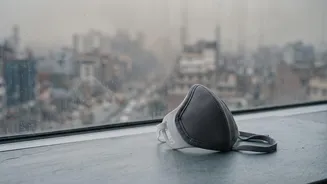


How Your Mask Actually Filters The Air
High-quality pollution masks, like N95s, are marvels of material science. They don't just physically block particles like a simple sieve. Their effectiveness comes from a complex web of non-woven plastic fibres. This material creates both a physical barrier
and an electrostatic charge. As you inhale, larger particles get trapped in the fibre maze, while smaller, more dangerous ones (like PM2.5) are pulled out of the air and stuck to the charged fibres, much like static electricity attracts dust. For this to work, two things are essential: the integrity of the filter media and a tight seal around your nose and mouth. Any break in either of these components renders the protection nearly useless.
When A Shield Becomes A Liability
Over time, your mask wages a constant battle with pollutants, and it shows. The filter clogs with trapped particles like dust and soot. Moisture from your own breath, sweat, and humidity in the air saturates the fibres. This clogging makes it harder to breathe, a key sign that the filter is spent. More importantly, this moisture can gradually neutralise the filter's crucial electrostatic charge, drastically reducing its ability to capture the smallest, most harmful particles. Studies have shown that a used mask is less effective at filtering fine particles under 2.5 micrometers than a new one. Furthermore, the straps can stretch, and the nose piece can lose its shape, leading to a poor seal that allows polluted air to leak in around the edges.
The Hidden Dangers Of A Dirty Mask
A compromised mask doesn’t just fail to protect you; it can become a health hazard in itself. The warm, moist environment created inside a frequently used mask is an ideal breeding ground for bacteria, yeast, and fungi. Re-wearing a contaminated mask means you could be breathing in these trapped microbes, which can lead to skin irritation like 'maskne', sore throats, or even respiratory infections. While a clean mask reduces your exposure, a dirty one can accumulate a high concentration of pollutants that you may then inhale. Think of it less as a filter and more as a dirty sponge held against your face.
Your Checklist For Replacement
Knowing when to swap out your mask is critical for your safety. Relying on a fixed schedule is good, but you should also inspect your mask before every use. Throw it away immediately if you notice any of these signs:
It’s visibly dirty: If the outside or inside is discoloured or soiled, its filtration capacity is compromised.
Breathing becomes difficult: This is a clear indicator that the filter is clogged with particles and needs to be replaced.
The seal is broken: If the straps are stretched or the mask no longer fits snugly against your face, it's no longer effective. Check for gaps by pinching the nose piece and ensuring there are no leaks around the edges.
It’s damaged or damp: Any tears, holes, or moisture saturation means it's time for a new one. Disposable respirators like N95s should not be washed or cleaned, as this damages the filter.
* You can smell or taste pollutants: For masks with vapour filters, this is a sure sign of 'breakthrough', meaning the filter is saturated.