





First, What Is an Optical Skyrmion?
Imagine a knot that can’t be easily untied. In essence, that’s a skyrmion. First theorized in the 1960s for particle physics, the concept was later applied to magnetic fields, describing incredibly stable, nanoscopic vortex-like patterns. These 'magnetic
skyrmions' are so robust they're being developed for next-generation data storage. Now, scientists have created an even more exotic version: the optical skyrmion. Instead of being patterns in a magnetic material, these are stable, swirling topological structures formed within the properties of light itself—like its polarization or phase. Think of it as sculpting light into a persistent, microscopic whorl that holds its shape. This is a huge leap because, unlike their magnetic cousins, optical skyrmions exist in light fields, which are massless, immune to electromagnetic interference, and travel, quite literally, at the speed of light.
What's New: Making Knots of Light
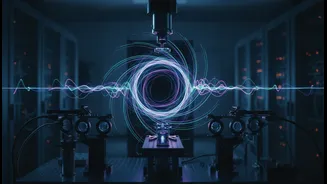
For a while, creating and controlling optical skyrmions was incredibly difficult, requiring complex, expensive, lab-grown materials called metasurfaces. This complexity limited how many researchers could study them. The big news is that this is changing rapidly. In a breakthrough announced in mid-2026, scientists at Nanyang Technological University in Singapore discovered a surprisingly simple method to generate optical skyrmions. They revived a 200-year-old physics experiment—the Poisson spot, where a bright dot of light appears in the center of a circular object's shadow—by simply shining a laser at a tiny disc. This unexpectedly simple setup not only produced optical skyrmions but generated four different types at once, allowing for unprecedented study. This development dramatically lowers the barrier to entry for research, opening the floodgates for more scientists to explore and experiment with these exotic light structures. Other recent advancements include creating devices that can switch between different types of skyrmions on demand, a critical step for using them to encode information.
What Matters: The Promise of Light-Speed Tech
The reason optical skyrmions are generating so much excitement is their immense potential to revolutionize technology. Their exceptional stability makes them perfect candidates for carrying information. Since they are robust against disturbances, data encoded in skyrmions would be less prone to corruption. This opens up possibilities for ultra-high-density data storage and faster, more energy-efficient computing. Beyond computing, their unique properties could lead to breakthroughs in other fields. In metrology, they could be used for super-resolution imaging, allowing us to see details far smaller than the wavelength of light used. They are also being explored for their role in quantum technologies; their inherent stability could be key to creating more resilient qubits, the building blocks of quantum computers. They could also form the basis for more secure and robust wireless communication systems.
What Remains Unclear: The Hurdles Ahead
Despite the excitement and rapid progress, optical skyrmions are far from being used in your next smartphone. Several significant challenges remain before they can be harnessed for practical applications. A primary hurdle is control and manipulation. While new methods have made generating them easier, precisely controlling, moving, and reading individual skyrmions on a massive scale is a complex engineering problem that is still in its infancy. Another issue is stability under real-world conditions. While topologically protected, scientists are still working to understand their robustness outside of pristine laboratory setups. Generating skyrmions efficiently and creating them in different materials and across various light spectrums are also active areas of research. Essentially, the field has moved from asking "Can we do this?" to "How can we do this reliably, compactly, and at scale?" Answering these questions is the next great frontier for physicists and engineers in this space.