

The Fifth State of Matter
When we think of states of matter, we usually stop at solids, liquids, gases, and maybe plasma. But there's a fifth state, one that only appears at temperatures just a fraction of a degree above absolute zero, or -273.15 degrees Celsius. At these extreme
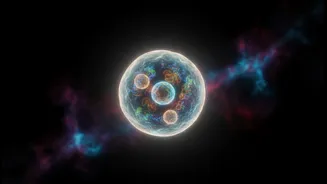
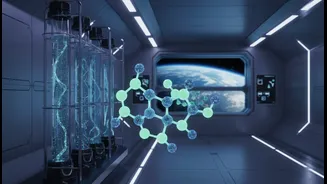
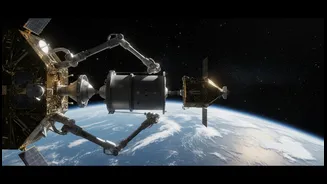
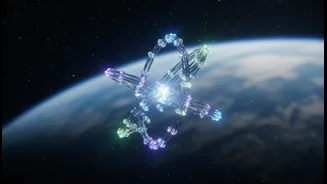
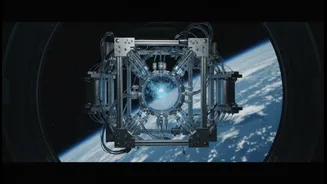
colds, clouds of atoms slow down so much that they lose their individual identities and begin to act as a single, unified quantum wave. This bizarre state is called a Bose-Einstein Condensate (BEC). First created in a lab in the 1990s, BECs allow scientists to observe strange quantum phenomena—like atoms behaving as waves—on a macroscopic scale, making them much easier to study. The research is being conducted in NASA's Cold Atom Lab (CAL), a sophisticated facility that was installed on the International Space Station in 2018.
Why Study Cold Atoms in Space?
Creating a BEC on Earth is incredibly challenging, primarily because of gravity. The moment the magnetic trap holding the ultra-cold atoms is released for observation, gravity pulls the cloud downwards, and it dissipates within milliseconds. This gives researchers only a fleeting moment to conduct their experiments. In the microgravity environment of the space station, however, the story is completely different. Atoms are in a state of continuous free-fall, which means gravity's pull is no longer a disruptive force. This allows the BECs to be observed for much longer periods—for many seconds at a time instead of fractions of a second. This extended observation window is a game-changer, enabling more precise measurements and experiments that are simply impossible on the ground. Furthermore, the weaker trap needed in space allows the atoms to expand and reach even colder temperatures than those achievable on Earth.
A Quantum Laboratory in Orbit
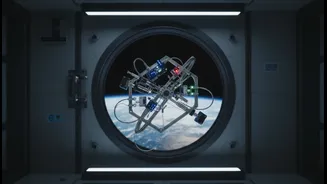
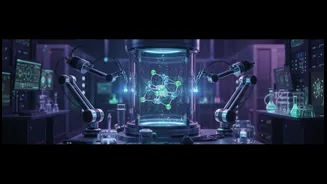
The Cold Atom Lab is essentially a room-sized physics laboratory shrunk down to the size of a mini-refrigerator. It’s operated entirely remotely by scientists back on Earth at NASA's Jet Propulsion Laboratory. Using a complex system of lasers, vacuum chambers, and magnetic fields, the CAL cools down atoms like rubidium and potassium to create and manipulate these quantum gases. The facility has been a resounding success, creating the first BECs in orbit shortly after its installation. The mission has been so valuable that it has received several upgrades, with the most recent enhancements in 2026 adding a redesigned magnetic trap to give researchers even more control over the shape and properties of the atom clouds they create. These upgrades ensure the lab remains at the forefront of quantum research.
Probing the Universe's Deepest Mysteries
The fundamental goal of the Cold Atom Lab is to explore the fuzzy border between our everyday world, governed by gravity and general relativity, and the bizarre microscopic world, ruled by quantum mechanics. By studying how these quantum waves behave over long periods, scientists hope to test some of physics' most foundational ideas, like Einstein's equivalence principle, with unprecedented accuracy. This principle states that gravity accelerates all objects at the same rate, regardless of their mass or composition. Probing it with ultra-cold atoms of different types could reveal tiny deviations that point toward new physics. This research could even provide clues to help us understand some of the biggest cosmic mysteries, such as the nature of dark matter and dark energy, which together make up most of our universe.
From the Cosmos to Your Pocket
While this might sound like abstract science, the history of quantum physics shows that its discoveries often lead to revolutionary technologies. The first quantum revolution gave us lasers, microchips, and MRI machines. Scientists believe this new era of research, dubbed 'Quantum 2.0', will be just as transformative. The work being done on the Cold Atom Lab could lead to next-generation quantum sensors with incredible sensitivity. Imagine atomic clocks so precise they could dramatically improve GPS navigation in deep space or on Earth. Other potential applications include new instruments that can monitor climate change by measuring tiny shifts in Earth's gravity, or sensors sensitive enough to detect gravitational waves from colliding black holes.