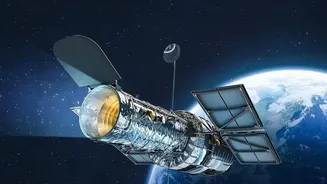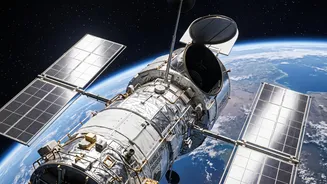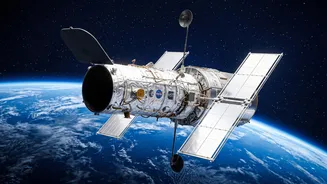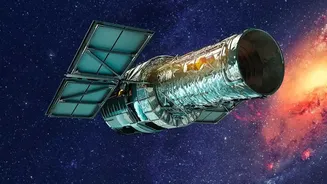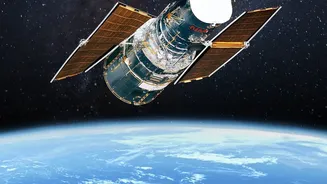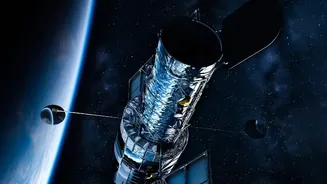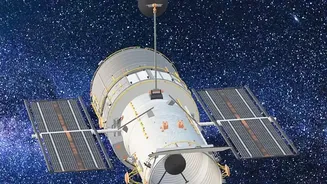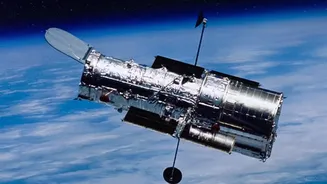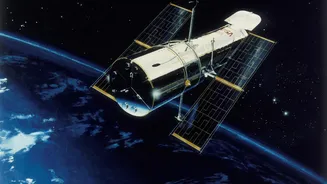



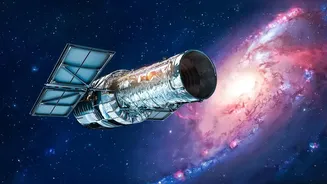
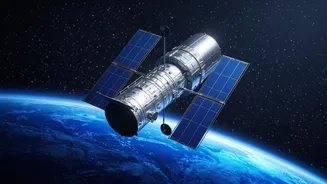
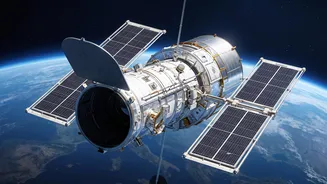
The Hubble Space Telescope, humanity’s legendary eye on the universe, is slowly falling. After more than 35 years of reshaping cosmology, its orbit is decaying. Now, NASA is turning to the private sector for a potential rescue.
A Fading Orbit for a Legendary Telescope
For over three decades,
the Hubble Space Telescope has delivered breathtaking images and groundbreaking science from its perch high above Earth. It has helped us understand the age of the universe, discover distant galaxies, and study the atmospheres of planets beyond our solar system. But while its scientific instruments remain powerful, its journey is threatened by a quiet, relentless force: atmospheric drag. Orbiting about 540 kilometres up, Hubble still encounters faint traces of Earth's atmosphere. This creates a tiny amount of resistance that, over many years, has caused its orbit to shrink. Unlike many spacecraft, Hubble has no onboard propulsion system to push itself back into a higher, more stable orbit. Projections now indicate that if nothing is done, the iconic observatory could make a fiery, uncontrolled re-entry into the atmosphere sometime between 2033 and 2034.
The 'Reboost' Mission Explained
To prevent the loss of this invaluable scientific asset, NASA is formally exploring a rescue. The leading concept is a 'reboost' mission. In simple terms, this would involve sending a new spacecraft to rendezvous with Hubble, physically dock with it, and then fire its own engines to push the telescope into a higher orbit. The goal outlined in NASA's recent request is to raise Hubble to an altitude of at least 600 kilometres, which could add another 15 to 20 years to its operational life. This would not only preserve a historic observatory but also ensure it can continue its scientific work well into the 2030s, potentially overlapping with the next generation of space telescopes. Since the last servicing mission by the Space Shuttle in 2009, NASA has lacked a vehicle designed for such a hands-on task, which is why it is now looking for commercial solutions.
NASA's Formal Call for Ideas
On October 29, 2026, NASA officially published a Request for Information (RFI), formally asking the private space industry for concepts. With a response deadline of November 30, 2026, the agency is moving quickly to assess its options. It's important to note that an RFI is not a contract; it is a form of market research. NASA is gathering data on what is technically feasible, what the risks are, and what the potential costs might be. The request is broad, asking companies for ideas on three potential paths: boosting Hubble to a higher orbit, servicing it with new technology, or planning for its safe and controlled de-orbit at the end of its life. Any potential mission would need to be executed by 2032 to be effective.
The Key Players and a New Model
While the RFI is open to all, one potential partnership has already been explored. In 2022, NASA and SpaceX conducted a joint study to assess the feasibility of using a SpaceX Dragon spacecraft for a reboost mission. That effort was part of the Polaris Program, a series of private missions funded by billionaire Jared Isaacman. Though NASA decided not to move forward at that time, the landscape of commercial space capabilities has evolved rapidly. Companies like Northrop Grumman and a host of startups are also developing in-space servicing technologies. This new request for information re–opens the door for these and other companies to present their solutions. A successful commercial mission to save Hubble would be a landmark achievement, establishing a new model for how public scientific assets are maintained and extending the life of irreplaceable infrastructure in orbit.