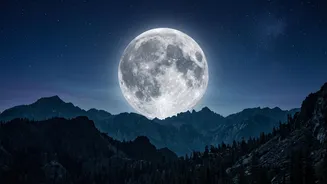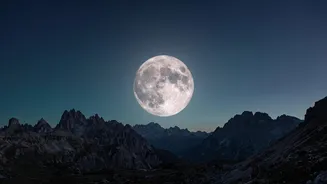


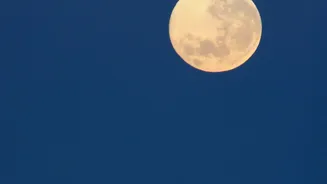
You’ve seen it a thousand times: a full moon hangs low on the horizon, looking impossibly large and cinematic. But a few hours later, high in the sky, it seems to have shrunk. What’s going on? It’s not magic; it’s a powerful trick of the mind.
The Scene of the Crime
First, let's
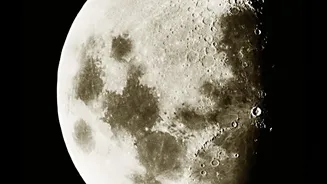
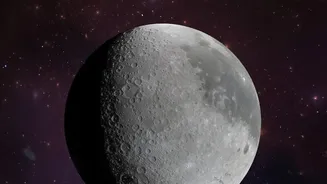
establish what isn't happening. The moon is not physically changing size, nor is it getting closer to Earth when it rises. In fact, when the moon is on the horizon, it's actually about 4,000 miles farther away from you than when it's directly overhead. And our atmosphere, while it can make the moon appear more orange or red, actually makes it look slightly squashed, not larger. Photographs confirm this: if you take a picture of the horizon moon and the zenith moon with the same camera settings, they will be the same size. So, if the moon isn't changing, something else must be responsible for this universal experience. That something is your brain, which is being fooled by a well-known psychological quirk.
Meet the Ponzo Illusion
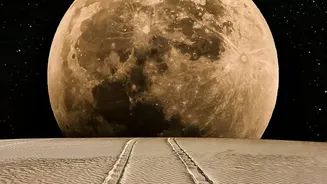
The primary culprit behind the Moon Illusion is thought to be the Ponzo illusion, first described by Italian psychologist Mario Ponzo around 1911. It’s a simple but powerful optical illusion that demonstrates how our brains use context to judge size. Imagine two identical horizontal lines drawn between a pair of converging lines, like railroad tracks receding into the distance. The top line will almost always appear longer than the bottom one, even though they are exactly the same length. Your brain sees the converging lines as a cue for linear perspective, interpreting the scene as having depth. It assumes the top line is farther away. And for an object that’s farther away to cast the same size image on your retina as a closer one, it must be physically larger. So, your brain automatically scales it up, creating the illusion.
Your Brain on the Horizon
This is precisely what happens with the moon. When the moon is high in the sky, it hangs in a vast, empty expanse. There are no visual cues to help your brain judge its distance. But when the moon is low on the horizon, it’s surrounded by familiar objects that provide a sense of scale and depth: trees, buildings, mountains, and the texture of the landscape itself. These objects act like the converging railroad tracks in the classic Ponzo illusion. Your brain sees the moon behind these terrestrial objects and perceives it as being very far away—much farther than the 'empty' sky overhead. Because it seems so distant, yet still takes up the same amount of space on your retina as the overhead moon, your brain's size constancy mechanism kicks in. It concludes that the horizon moon must be enormous and 'inflates' its perceived size to match the perceived distance.
Is It Just One Thing?
While the Ponzo illusion is the leading explanation, it's likely not the only factor. Another related idea is the 'apparent distance hypothesis,' which suggests we perceive the sky not as a perfect hemisphere but as a flattened dome. In this mental model, the horizon feels much farther away than the point directly overhead (the zenith). This distorted sense of the sky's shape would also cause our brains to scale up the size of any distant object on those horizons. Some researchers also point to a 'relative size' illusion; the moon appears larger when compared to any small, distant trees and buildings on the horizon, whereas it seems smaller when surrounded by any vast emptiness of any night sky. Ultimately, any Moon illusion is a complex interplay of different cognitive shortcuts that our brains use to make sense of a 3D world with 2D information from our eyes.