







Spain's magnificent landmarks draw millions, but for travellers with mobility issues, the reality can be a mixed bag of modern accessibility and ancient obstacles. Navigating these historic sites requires planning, patience, and a little inside knowledge.
The Alhambra, Granada: A Hillside Challenge
Granada's Alhambra is a sprawling palace complex on a hill, which immediately presents challenges. While significant effort has been made to improve access, it remains only partially accessible. An official wheelchair route exists, covering many key areas, including the stunning Court of the Myrtles and Court of the Lions in the Nasrid Palaces. However, visitors should be prepared for some steep ramps and uneven surfaces. The fortress-like Alcazaba and parts of the Generalife gardens are not accessible due to stairs and inclines. The site offers a free wheelchair loan service at the main entrance, but these cannot be booked in advance. It is strongly recommended to use the main entrance pavilion, which has reserved parking and is the start of the designated accessible path.
Sagrada Família, Barcelona: Impressive, with One Big Exception
Gaudí's unfinished masterpiece is a model of modern accessibility, for the most part. The main basilica, museum, and shop are fully step-free, with wide, smooth pathways perfect for wheelchair and mobility scooter users. There is a dedicated, priority entrance for visitors with reduced mobility on Carrer de la Marina. The one major limitation is the towers. While there are elevators to go up, the descent is via a long, narrow spiral staircase, making them inaccessible for anyone with mobility issues. However, the breathtaking experience of the basilica's interior—with its forest of columns and kaleidoscopic light—is entirely accessible from the ground floor. The Sagrada Família also offers free admission to visitors with a certified disability of 65% or higher, along with one companion.
Park Güell, Barcelona: A Tale of Two Halves
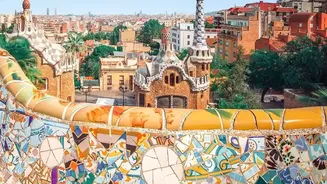
Built on a steep hill, Park Güell is notoriously challenging. While the park's operator is transparent about the difficulties, significant portions of Gaudí's whimsical creation can still be enjoyed. The ticketed 'Monumental Zone', which includes the famous mosaic terrace and the Hypostyle Room, is reachable via an adapted itinerary. The key is to use the correct entrance: the Carretera del Carmel entrance is the most accessible and avoids the steep main stairway. The park offers free admission for visitors with a recognised disability, has a wheelchair loan service, and even has an official app with an accessibility layer to help navigate the best routes. However, many of the winding paths outside the main zone are steep and uneven, and an electric wheelchair or strong assistance is recommended for manual chair users.
Prado Museum, Madrid: A Model of Accessibility
In contrast to many historical sites, Madrid's world famous Prado Museum is fully accessible and a benchmark for inclusive design. The entire museum has step free routes, ramps, elevators, and accessible restrooms. The key piece of advice for visitors with mobility issues is to use the Jerónimos entrance on the west side of the building; this is the dedicated accessible entrance and provides priority access, bypassing the main queues at the Goya entrance which has steps. The museum offers free wheelchair loans and provides an accessible map detailing a route that covers its most famous masterpieces, such as Velázquez's 'Las Meninas' and Goya's 'Black Paintings', without encountering stairs. Visitors with a disability and one companion can also enter for free upon presenting proof.
Royal Palace of Madrid : Fit for a King
The official residence of the Spanish Royal Family is another of Madrid's highly accessible attractions. The main tour route, covering the opulent state rooms and Royal Armory, is fully adapted for wheelchair users with ramps and elevators. Similar to the Prado, visitors with a disability are granted free admission. The recommended entrance is via the Plaza de la Armería, which has a step free route from the street. The palace also provides a limited number of wheelchairs for visitors to borrow free of charge, though it's wise to inquire about availability in advance, especially during peak tourist season. Overall, the experience is grand and largely barrier free, allowing all visitors to immerse themselves in the history and splendour of the Spanish monarchy.