



Earth’s Invisible Force Field
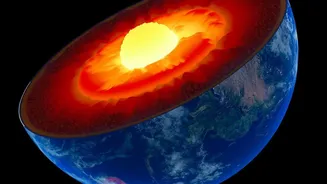
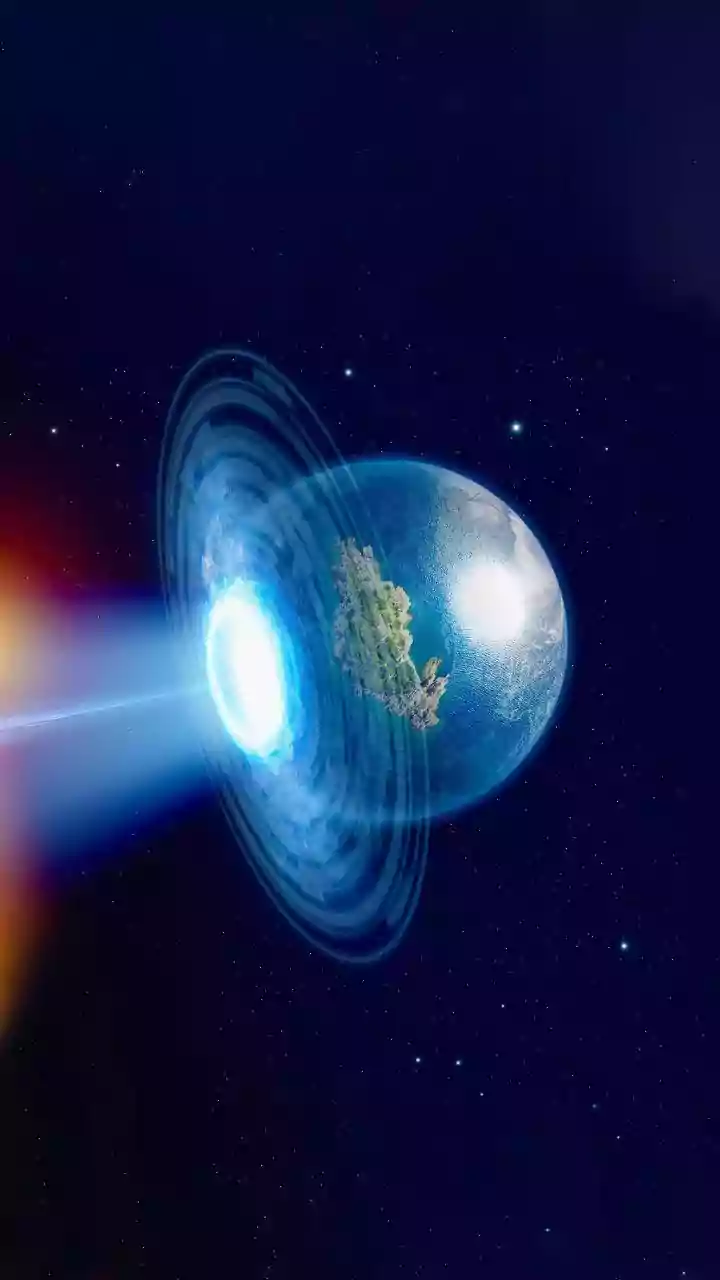
Imagine an enormous, invisible bubble surrounding our planet. This is the magnetosphere, a vast, comet-shaped region dominated by Earth's magnetic field. It's not a physical structure, but a field of force generated by the churning of molten iron in our planet's
outer core. This 'geodynamo' effect, driven by the planet's rotation and heat from the core, creates a powerful magnetic dipole, similar to a giant bar magnet tilted slightly from Earth’s rotational axis. The side facing the sun is compressed by the constant pressure of the solar wind, a stream of charged particles flowing from the sun, extending out to about 60,000 kilometres. The night side is stretched into a long 'magnetotail' that reaches hundreds of thousands of kilometres into space, far beyond the Moon. This immense magnetic shield is not unique to Earth, but ours is the strongest among the rocky planets, playing a crucial role in our planet's ability to sustain life.
The Menace from Deep Space
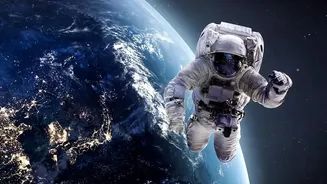
The primary threat the magnetosphere protects us from are galactic cosmic rays (GCRs). These are not rays in the traditional sense, but the atomic nuclei of elements—mostly protons (hydrogen nuclei)—that have been stripped of their electrons and accelerated to nearly the speed of light. Originating from cataclysmic events like supernovae across our galaxy, these particles are immensely powerful. They are a constant, pervasive form of radiation. If these particles were to reach the surface unimpeded, they would be lethal to life. Their high energy allows them to penetrate deep into biological tissues, damaging DNA, increasing the risk of cancer and other illnesses, and ultimately making the planet's surface uninhabitable. This constant bombardment is a major hazard for astronauts on long-duration missions outside of Earth's protective field.
How the Shield Works
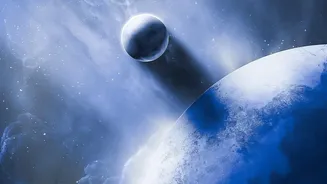
The magnetosphere's power lies in its ability to deflect charged particles. Because GCRs and particles from the solar wind are electrically charged, they are forced to react to magnetic fields. When these particles encounter Earth's magnetosphere, most are redirected, flowing around our planet like water around a boulder in a stream. The magnetic field lines guide these dangerous particles away from Earth, preventing them from penetrating the atmosphere and reaching the surface. This deflection not only protects life from direct radiation damage but also preserves our atmosphere. Without the magnetosphere, the solar wind would gradually strip away our atmospheric gases, just as it did on Mars, eventually boiling away our oceans and leaving behind a barren, irradiated world.
The Cautionary Tale of Mars
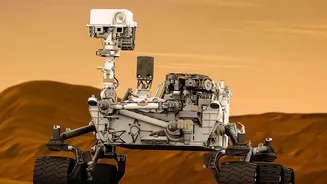
To understand the magnetosphere's importance, we only need to look at our neighbour, Mars. Billions of years ago, Mars had a global magnetic field, a thicker atmosphere, and likely, liquid water oceans on its surface. However, because Mars is smaller than Earth, its core cooled and solidified. The geodynamo stopped, and its planetary magnetic shield vanished. Without this protection, the solar wind relentlessly stripped away the Martian atmosphere over millions of years. With the atmosphere gone, the air pressure dropped, and the water evaporated and was lost to space. Today, Mars is a cold, dry desert with a thin atmosphere, its surface constantly bombarded by lethal radiation. The fate of Mars is a stark reminder of what can happen to a planet that loses its magnetic protection.
When the Shield Bends
Earth's magnetic shield isn't entirely impenetrable. Some particles can become trapped within it, forming two doughnut-shaped zones of intense radiation known as the Van Allen Belts. These belts, discovered in 1958, pose a hazard to satellites and astronauts who must pass through them quickly. Furthermore, the magnetosphere has weak points near the magnetic poles. Here, the field lines funnel downward, allowing some charged particles from the solar wind to enter our upper atmosphere. When these particles collide with oxygen and nitrogen atoms, they excite them, causing them to glow. The result is one of nature's most spectacular displays: the aurora borealis and aurora australis, a beautiful side effect of our planet's essential defense system.