




The Fiery Re-entry Problem
Anything returning to Earth from space, whether it's a crew capsule or a precious rock sample from another world, has to survive a trial by fire. Hitting the atmosphere at hypersonic speeds—many times the speed of sound—compresses the air in front of the vehicle,
generating immense heat that can reach thousands of degrees Celsius. For over 60 years, the solution has been the rigid heat shield, an ablative or ceramic-tiled bowl that absorbs and deflects this thermal energy. But this tried-and-tested technology has a fundamental limitation: a heat shield can't be wider than the rocket fairing it launches in. This size constraint puts a hard cap on how much mass we can land, as a larger, heavier payload needs a larger shield to create enough drag to slow down. This is especially true for planets with thin atmospheres, like Mars.
An Inflatable, Game-Changing Solution
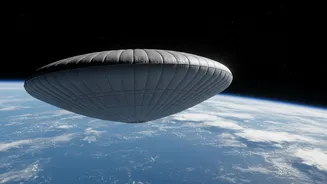
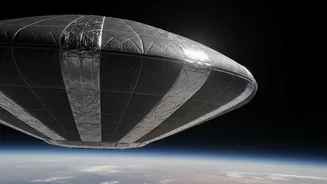
Imagine trying to solve this problem not with a bigger, stronger shield, but with a giant, high-tech inflatable one. That's the core idea behind the Hypersonic Inflatable Aerodynamic Decelerator, or HIAD. It's a technology that allows a heat shield to be packed into a small volume for launch and then inflated to a massive size just before it's needed. Think of it less like a party balloon and more like a sophisticated, multi-layered airbag that deploys in the vacuum of space. Once inflated, it acts like a giant brake, using the principles of aerodynamic drag to slow the spacecraft far more effectively than its rigid counterparts. By creating a much larger surface area, it can start slowing the vehicle down higher up in the atmosphere, where the air is thinner, reducing both the peak heating and the G-forces experienced by the payload.
How It Works: From Compact to Colossal
The engineering behind an inflatable heat shield is remarkable. The structure is typically made of a series of stacked, inflatable rings, or tori, woven from synthetic polymers that are stronger than steel by weight. This allows the structure to be flexible enough to fold but incredibly strong and rigid once inflated. The outer surface, which faces the intense heat of re-entry, is covered by a flexible thermal protection system. This consists of layers of advanced materials, including an outer layer of heat-resistant ceramic fabric, followed by high-temperature insulators that prevent heat from reaching the inflatable structure. When the time comes, a gas inflation system fills the structure, expanding it from a compact package into a fully deployed, large-diameter shield in minutes.
NASA's Landmark LOFTID Test
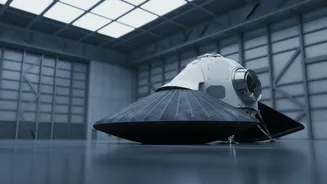
While the concept has been in development for years, it was NASA's Low-Earth Orbit Flight Test of an Inflatable Decelerator (LOFTID) mission in late 2022 that proved it was ready for the big leagues. Launched as a secondary payload, the LOFTID vehicle inflated its six-meter-wide heat shield in space and then deliberately re-entered the atmosphere at more than 29,000 kilometres per hour. It successfully survived the extreme temperatures and pressures, splashing down safely in the Pacific Ocean for recovery. The mission was a resounding success, demonstrating that the inflatable technology could not only survive the ordeal but also effectively protect its payload, opening the door for its use in future, more ambitious missions.
A New Frontier for India and the World
The potential of this technology has not gone unnoticed by global space agencies, including the Indian Space Research Organisation (ISRO). In 2022, ISRO successfully tested its own Inflatable Aerodynamic Decelerator (IAD), developed by the Vikram Sarabhai Space Centre. Though a smaller-scale test, it demonstrated India's capability in this cutting-edge field. ISRO views the IAD as a key technology for future missions, including recovering spent rocket stages to reduce launch costs and enabling the landing of larger payloads on Mars or Venus. Globally, these inflatable shields are seen as a critical enabler for landing human habitats on Mars, returning large asteroid samples, and even recovering and reusing the expensive engine sections of next-generation rockets, making access to space more sustainable and affordable.