



Listening for Ice Below the Surface
Imagine trying to find something buried underground without digging. That's the challenge scientists face on the Moon. A groundbreaking new method proposes using seismic waves—the same kind of vibrations from earthquakes—to locate buried ice. Researchers
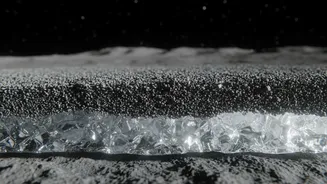
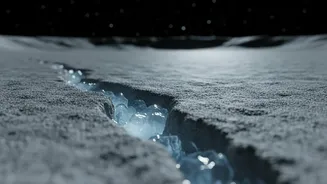
have found that seismic waves travel two to three times faster through frozen, ice-rich soil compared to dry lunar soil, or regolith. Ice-rich areas can also reflect these vibrations like an echo. By placing seismometers on the lunar surface, future missions could generate small, controlled quakes (for example, from a rover's drill) and listen for these tell-tale speed changes and echoes. This would allow them to map out subsurface ice deposits that are too deep for orbiting satellites to see.
An Advanced Radar Advantage
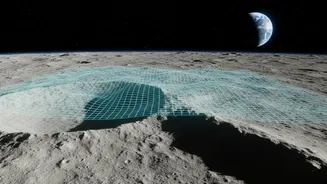
Another powerful technique involves analysing the electrical properties of the lunar soil. This method, advanced by data from India's Chandrayaan-2 orbiter, uses radar to measure something called the dielectric constant. In simple terms, dry lunar regolith has a low dielectric value, while water ice has a significantly different one. By sending radar signals into the ground and analysing the reflection, scientists can distinguish between rock and ice. Recent studies using this method have provided strong evidence of thick, buried ice deposits in the permanently shadowed craters near the Moon’s south pole. This radar data provides a crucial 'ground truth' that complements orbital observations, helping to pinpoint the most promising locations for ice.
Why the Poles Are Prime Real Estate
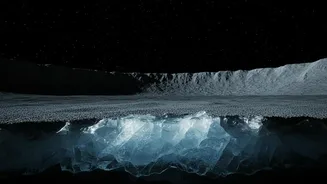
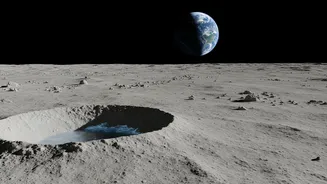
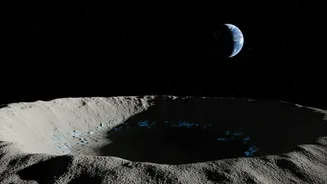
The Moon’s poles are the epicentre of the search for water for a key reason: permanently shadowed regions (PSRs). These are craters and depressions that haven't seen direct sunlight in billions of years, creating some of the coldest spots in our solar system. This extreme cold acts as a perfect trap, allowing water ice, likely delivered by comets and asteroids, to remain frozen and stable over immense timescales. While earlier missions found hints of hydrogen—a key component of water—at the poles, these new subsurface techniques are designed to confirm not just its presence, but its form (ice), depth, and concentration.
The Indian Connection to Lunar Water
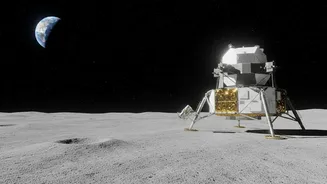
India's Chandrayaan missions have been central to our modern understanding of lunar water. It was Chandrayaan-1 in 2009 that provided some of the first definitive proof of water molecules on the Moon. More recently, the advanced radar aboard the Chandrayaan-2 orbiter has been instrumental in the search for subsurface ice. These findings directly inform global efforts and highlight India’s key role in lunar exploration. The upcoming LUPEX mission, a joint effort between India's ISRO and Japan's JAXA, plans to send a rover to the south pole specifically to investigate water ice, potentially using some of these very techniques to explore the ground.
Fueling the Future of Exploration
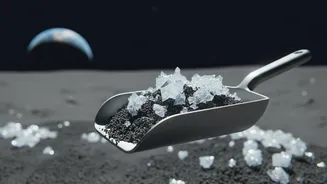
Finding accessible water ice is not just a scientific curiosity; it's a game-changer for the future of space exploration. Hauling water from Earth is incredibly expensive. If astronauts can 'live off the land' by harvesting lunar ice, they can produce drinking water, breathable oxygen, and even hydrogen for rocket fuel. This would make long-term lunar bases, like those planned under NASA's Artemis program, far more sustainable and affordable. These new detection methods are therefore critical first steps, providing the maps needed to guide future robotic and human missions to the most resource-rich locations on the Moon.