









The Two-Language Problem
An academic Curriculum Vitae (CV) and an industry resume serve different purposes. A CV is a comprehensive record of your scholarly life, often running for many pages, designed to prove your expertise to other academics. It details publications, conference
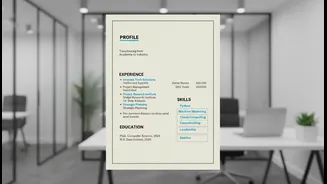
presentations, and teaching duties. In contrast, an industry resume is a one-to-two-page marketing document designed to convince a hiring manager you can solve their company's problems and contribute to their bottom line. Recruiters, who may spend only seconds on an initial scan, are not looking for a complete history; they are looking for evidence of specific, relevant skills and a track record of creating value.
Translate Duties into Outcomes
Industry hiring managers think in terms of impact. Instead of listing what you did, focus on what you achieved. Every bullet point on your resume should tell a story of success, ideally with a number to prove it. For example, a CV entry like "Taught undergraduate seminar on 19th-century literature" becomes a results-driven resume point: "Developed and delivered curriculum for a 40-student seminar, achieving a 95% positive feedback rating and improving student engagement metrics." Similarly, "Conducted research on protein folding" can be reframed as "Managed a two-year research project that identified a novel protein interaction, leading to a new methodology now adopted by three other labs." This shift demonstrates not just activity, but tangible, valuable results.
Showcase Transferable Skills
Your academic background has equipped you with a powerful set of transferable skills, but you must make them explicit. Don't assume a recruiter will connect the dots. Translate your academic experience into the language of business. Grant writing demonstrates persuasive communication and budget management. Managing a research lab shows project management, leadership, and operational oversight. Peer-reviewing articles is a form of critical analysis and quality control. Create a 'Core Competencies' or 'Skills' section that lists these abilities using industry keywords like 'Data Analysis (Python, R)', 'Project Management', 'Stakeholder Communication', and 'Critical Thinking'.
Frame Your Work as Problem-Solving
At its core, every industry job is about solving a problem for the employer. Your resume needs to position you as a problem-solver. Instead of describing your dissertation topic in academic terms, explain the problem it addressed and the solution you created. For example, don't just say you "investigated the rhetorical strategies of ancient texts." Instead, try: "Analyzed complex, unstructured data sets to identify hidden patterns and communication strategies, developing a new framework for interpretation that resolved a long-standing scholarly debate." This approach shows you can take on a complex challenge, develop a methodology, and deliver a solution—skills highly prized in any corporate environment.
Clean Up the Formatting
An industry resume must be concise and easy to scan. Limit it to two pages at most. Replace dense paragraphs with action-oriented bullet points that start with strong verbs like 'developed', 'managed', 'analyzed', or 'launched'. Your extensive list of publications, a badge of honor in academia, should be heavily curated. Include only the most relevant or prestigious publications, or create a link to an online portfolio. Finally, remove academic-specific jargon. Your goal is to make your value immediately clear to a non-expert audience, ensuring your resume passes both the automated keyword scan from an Applicant Tracking System (ATS) and the quick glance from a human recruiter.