




What You're Actually Seeing
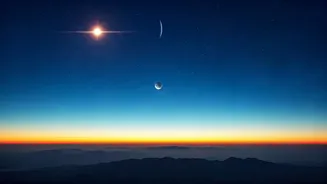
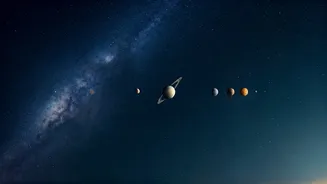
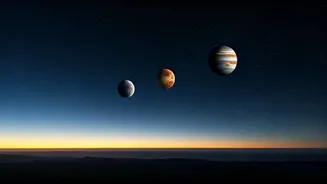
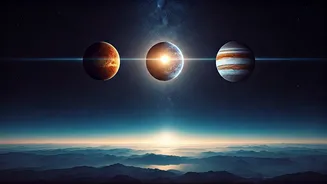
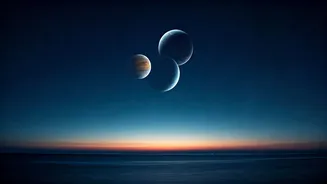
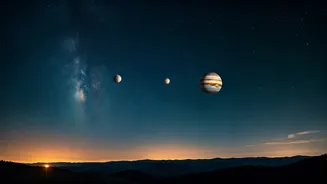
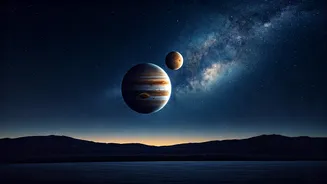
When we talk about a planetary “alignment,” it’s not a straight line of planets in space. Instead, it’s a beautiful line-of-sight illusion. From our perspective here on Earth, these planets will appear to be clustered closely together in a small patch
of sky. Venus will be the easiest to spot; it’s the brightest object in the evening sky after the Moon, an unmistakable silver beacon. Jupiter will be the next brightest, a steady, brilliant point of light. The real prize is Mercury. As the closest planet to the Sun, it never strays far from its glare, making it notoriously difficult to see. This alignment provides a rare chance to spot it, using brilliant Venus and Jupiter as celestial signposts.
When and Where to Look
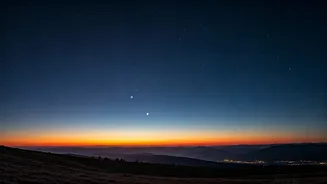
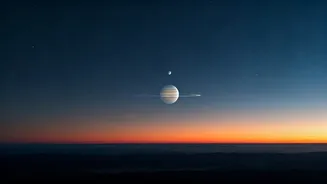
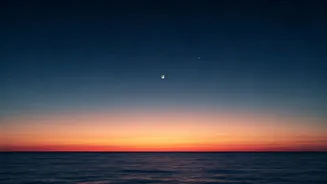
The key to seeing this trio is timing and location. You’ll need to find a spot with a clear, unobstructed view of the western horizon. Think beaches, the far side of a large maidan, or a high-rise balcony facing west. Light pollution from cities can wash out fainter objects, so the darker your location, the better your chances of spotting all three planets. The best viewing window begins about 30 to 45 minutes after sunset, during twilight. The sky will still have a deep blue or orange glow, which is perfect because if you wait for full darkness, Mercury will have already dipped below the horizon. Venus and Jupiter will be visible first, and as the sky darkens, faint Mercury should pop into view nearby.
How to Photograph with Your Smartphone
You don't need a fancy camera to capture this moment. Your smartphone is surprisingly capable, with a few tweaks. First, stability is everything. Use a small tripod or prop your phone securely on a stable surface like a wall or a beanbag. Any handshake will result in a blurry mess. Next, switch to your camera’s ‘Night Mode’ if it has one. This automatically uses a longer exposure to gather more light. If you have a ‘Pro’ or ‘Manual’ mode, use it! Lower the ISO to around 100-400 to reduce graininess and set the shutter speed to a few seconds (you'll need the tripod for this). Finally, use the camera’s self-timer (2 or 3 seconds). Tapping the screen to take the photo causes a tiny shake; the timer ensures the phone is perfectly still when the picture is taken.
Tips for DSLR and Mirrorless Cameras
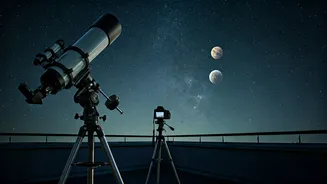
For those with a dedicated camera, you have more creative control. Start with a tripod—it's non-negotiable for astrophotography. Use a wide-angle or standard lens (18-55mm is fine) to capture the planets within the context of the twilight sky. Switch to Manual mode (M). Set your aperture wide open (the lowest f-number, like f/2.8 or f/4) to let in maximum light. Set your ISO between 400 and 1600. Your shutter speed will be a balancing act; start with 2-5 seconds. If the sky is too bright, shorten the shutter speed. If the planets are too dim, lengthen it. Most importantly, use manual focus. Point your camera at bright Venus, magnify the view on your screen, and turn the focus ring until the planet is a sharp, tiny pinpoint of light. Shoot in RAW format if you can; it gives you much more flexibility for editing later.
Compose a Better Shot
A picture of three dots in the sky is nice, but a picture that tells a story is better. Don’t just point your camera at the sky; think about the foreground. Including a silhouette of a tree, a temple spire, a city skyline, or the shoreline can add depth and context to your photograph. It frames the celestial event and grounds it in a recognisable landscape, making your final image far more compelling. Walk around your chosen viewing spot before sunset and find an interesting compositional element to include in your shot. This simple step elevates a snapshot into a thoughtful photograph.