





More Than Just Footprints
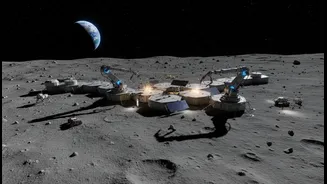
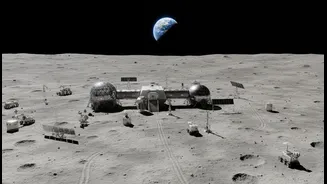
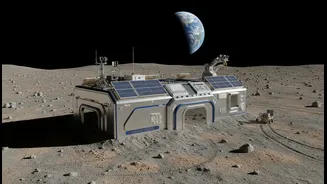
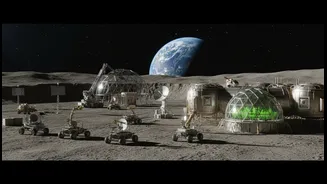
For the first time since 1972, humanity is establishing a long-term presence on the Moon. Unlike the fleeting Apollo missions, the Artemis program aims to create a sustainable base camp at the lunar South Pole. This isn't about short visits; it's about building
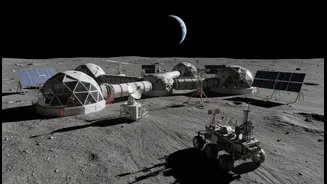
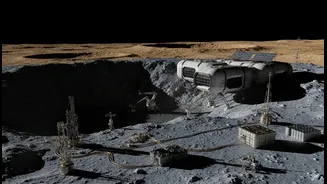
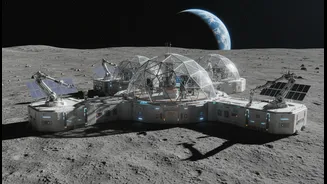
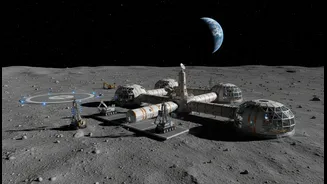
an outpost for science and exploration. The Artemis Base Camp will include habitats, rovers, and power systems, serving as a hub for astronauts to live and work for extended periods. The core purpose is to use the Moon as a unique laboratory and a stepping stone for more ambitious journeys, most notably the human exploration of Mars.
A Window into Our Solar System
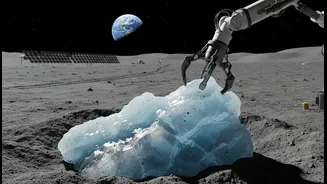
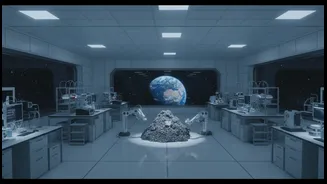
The Moon is a 4.5-billion-year-old time capsule. Because it has no atmosphere and very little geological activity, its surface preserves a pristine record of the early solar system. By studying ancient craters, like the massive South Pole-Aitken Basin, scientists can investigate the 'lunar cataclysm,' a hypothesized period of intense asteroid bombardment that would have also shaped early Earth. A top priority is analyzing the water ice confirmed to exist in permanently shadowed craters near the South Pole. Rovers like the VIPER mission are designed to map these ice deposits, which hold clues to the delivery of water and organic molecules across the solar system.
Unlocking Lunar Resources
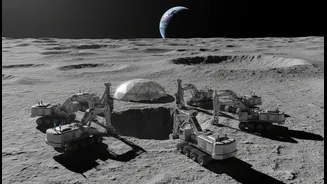
Living off the land, or in-situ resource utilization (ISRU), is a game-changer for space exploration. The cost of launching materials from Earth is immense, making self-sufficiency crucial. Lunar water ice is the primary target. It can be split into hydrogen and oxygen, providing breathable air for astronauts and, critically, the components for rocket propellant. This would effectively turn the Moon into a refueling station for missions deeper into space. Other resources include lunar soil, or regolith, which can be used in 3D-printing to build landing pads and habitats, and potentially rare metals like helium-3, a theoretical fuel for future clean fusion energy.
A Unique Perch for Astronomy
The far side of the Moon is the most radio-quiet location in the inner solar system, shielded from the constant chatter of Earth's communications and atmospheric interference. This makes it an ideal place for a new generation of radio telescopes. Concepts like the FarView Observatory envision vast arrays of antennas that could study the universe's 'Dark Ages'—the era after the Big Bang but before the first stars formed—by detecting faint, ancient hydrogen signals. Such observatories could revolutionize our understanding of cosmology in the same way the Hubble and James Webb telescopes have for optical astronomy.
The Proving Ground for Mars
Every system tested and lesson learned on the Moon is a direct rehearsal for sending humans to Mars. Operating a base in the harsh lunar environment—with its extreme temperatures, radiation, and abrasive dust—will allow NASA and its partners to perfect the technologies needed for a multi-year journey to the Red Planet. This includes advanced life support and water recycling, habitat construction, power generation via solar or nuclear systems, and long-range rovers. The challenges of a two-month stay on the Moon will prepare crews for a two-year mission to Mars, making the lunar base an essential training ground.
Real Benefits for Life on Earth
The push to solve complex challenges in space consistently leads to innovations that improve life on Earth. These 'spinoffs' are a major, if often overlooked, return on investment. The original Apollo program contributed to everything from GPS to medical imaging and cordless tools. The Artemis program is already generating new technologies in areas like 3D printing for construction, advanced battery systems, and material science. Technology developed to grow plants on the Moon could inform vertical farming on Earth, while advanced water-recycling and purification systems have clear applications in water-scarce regions. Ultimately, pushing the boundaries of human ingenuity in space forces us to become more resourceful and sustainable back home.