



A Sweet Discovery in a Cosmic Cloud
In a remarkable finding, astronomers have detected erythrulose, a four-carbon sugar, within a vast molecular cloud known as G+0.693-0.027. This enormous cloud of gas and dust is located roughly 27,000 light-years away, near the supermassive black hole
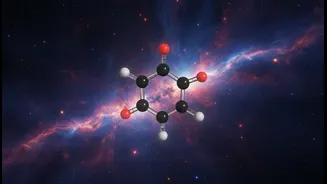
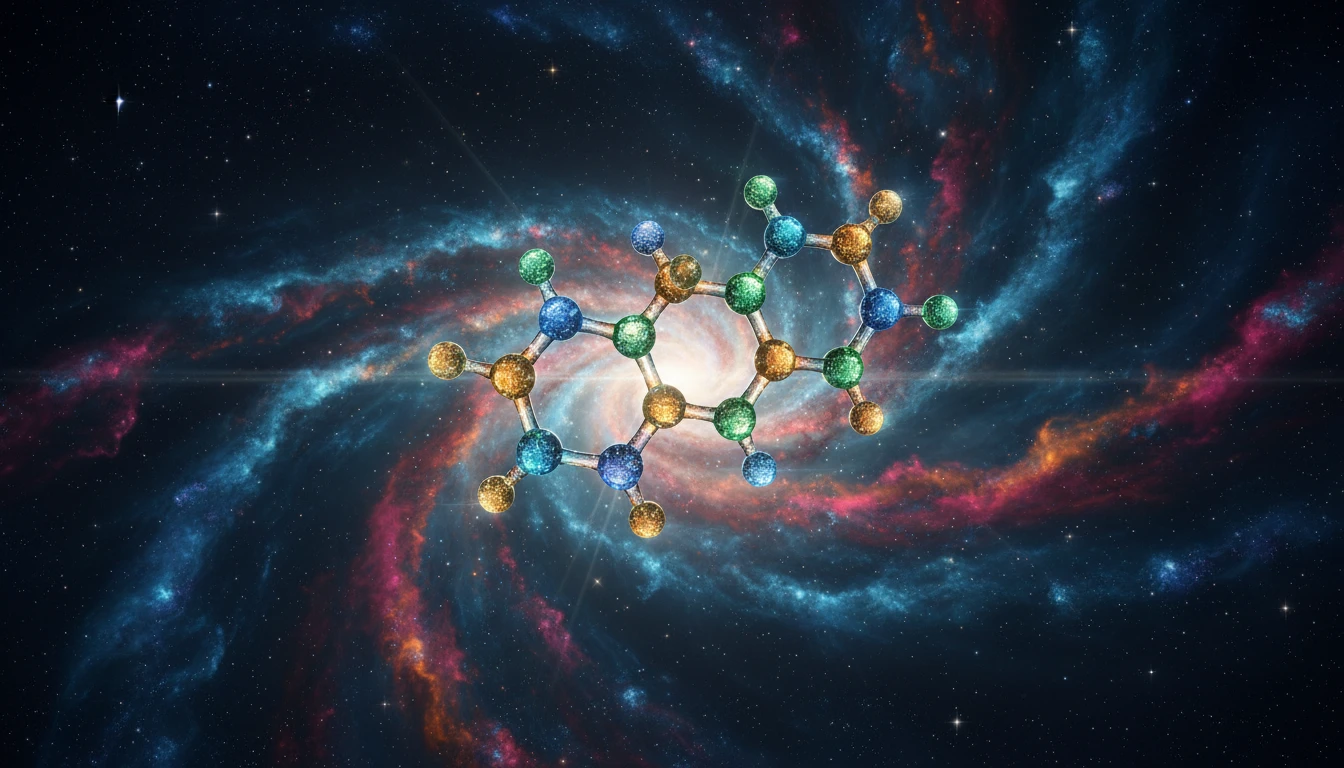
at the center of our Milky Way. Using highly sensitive radio telescopes in Spain, a team of researchers identified the specific radio-wave signature of erythrulose, matching it to patterns measured in a laboratory. This is the first time a true sugar of this complexity has been found in interstellar space. While simpler molecules have been found before, erythrulose is significant because sugars are fundamental to life as we know it, forming the structural backbone of RNA and DNA and providing metabolic energy.
More Than Just Sugar
Finding erythrulose in space is a game-changer because it was previously unclear if such complex molecules could form in the harsh, cold environment between stars. Many models of early Earth struggle to explain how enough sugar could have formed on the planet's surface to kickstart life. This discovery provides strong evidence for an alternative theory: the building blocks of life didn't necessarily form on Earth. Instead, they were likely cooked up in interstellar space and delivered to young planets by comets and asteroids. The research team calculated that millions of tons of erythrulose could have landed on early Earth during a period known as the Late Heavy Bombardment, about 4 billion years ago. This cosmic delivery service would have provided a ready-made chemical toolkit for prebiotic chemistry to work with.
A Question of Handedness
Erythrulose is also what scientists call a 'chiral' molecule. Like your hands, chiral molecules come in two mirror-image forms—a 'left-handed' and a 'right-handed' version—that cannot be perfectly superimposed on one another. Intriguingly, life on Earth exclusively uses one handedness of molecules, such as left-handed amino acids and right-handed sugars. Why this preference exists is one of the great mysteries of biology. The detection of a chiral molecule like erythrulose in a pre-stellar cloud suggests that the preference for a specific handedness might originate in space, long before planets even form. While the telescopes could not distinguish between the left- and right-handed versions, the mere presence of a chiral molecule in this environment opens up a new avenue for studying how this fundamental asymmetry of life might have begun.
A Chemical Map for New Worlds
By detecting erythrulose, scientists are essentially creating a chemical map of the raw materials available in a stellar nursery. Molecular clouds like G+0.693-0.027 are the birthplaces of stars and their planetary systems. Identifying the inventory of complex molecules present in these clouds tells us what ingredients are available to be incorporated into newly forming planets. This shows that the process of creating life's building blocks is not a fluke that happened only in our solar system, but a potentially universal process. The discovery was unexpected because scientists had been looking for simpler, three-carbon sugars and found none, yet they found the more complex four-carbon erythrulose in abundance. This suggests that chemical complexity in space can build up in surprising ways, perhaps on the icy surfaces of dust grains.