


Get ready, India. The world’s biggest rocket, SpaceX's Starship, is scheduled to fly over the country during its next ambitious test flight. Here’s what’s happening, what it means for space travel, and how you might be able to spot it.
An Orbital Test with a Twist
SpaceX is targeting
as early as November 14 (IST) for its fifteenth major test flight of the Starship system. Unlike previous suborbital tests that ended with a splashdown in the Indian Ocean within an hour, this mission is far more ambitious. The plan is for the Starship upper stage to enter Earth's orbit, circle the globe approximately 14 times over 22 hours, and then attempt a revolutionary landing back at its launch site in Texas. During its time in orbit, the spacecraft will also deploy a batch of 26 Starlink internet satellites. This extended orbital phase means the vehicle will pass over numerous countries, including India, multiple times.
When and Where to Look Up
The launch is planned from Texas, with a window opening in the early morning hours of November 14 for viewers in India. Because the spacecraft will complete about 14 orbits at an altitude of roughly 275 kilometres, there will be multiple opportunities to see it from India. Skywatchers will need to check online spacecraft tracking sites for precise timings and locations for their specific city. A vehicle at that altitude is often visible during twilight hours—just after sunset or before sunrise—when the sky is dark but the spacecraft is still illuminated by the sun. It will likely appear as a steady, bright point of light moving silently and swiftly across the sky, similar to the International Space Station, but on a different path.
A Safe Passage Overhead
Any time a spacecraft's path includes populated areas, safety is the top priority. Starship's orbital journey is planned at a very high altitude, far above commercial air traffic, posing no danger to people on the ground. In fact, this flight profile is part of a long history of crewed and uncrewed vehicles, including the Space Shuttle and Dragon capsules, safely flying over land. SpaceX has also designed the mission with built-in safety measures. If any issues arise before the final commitment to orbit, the spacecraft is designed to follow a 'passively safe' trajectory that would lead to a controlled splashdown in a cleared area of the Indian Ocean, a procedure honed over several previous test flights.
The Fiery Spectacle of Reentry
While this mission aims for a landing in Texas, past Starship flights have provided spectacular views of the spacecraft reentering the atmosphere over the Indian Ocean. As a vehicle travelling at over 26,000 km/h hits the upper atmosphere, the compression of air creates a superheated sheath of plasma around it, making it glow intensely. During one test, Starship sent back live video from within this plasma field at an altitude of 77 kilometres. Though the final reentry for this flight is not planned over India, the country has had a front-row seat to the conclusion of previous missions, which have targeted the Indian Ocean for splashdown to maximize public safety while testing the vehicle's heat shield and flight controls.
Why This Flight Matters
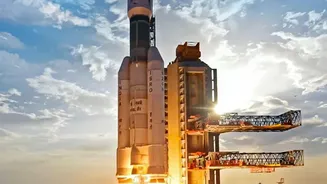
This mission, known as Flight 15, is a crucial step toward SpaceX's ultimate goal: creating a fully and rapidly reusable transportation system to make space travel cheaper and more frequent. The headline objective is to catch not only the Super Heavy booster (which has been done before) but also the Starship upper stage using the massive 'chopstick' arms on the launch tower. A successful catch would be a historic first, proving the viability of the entire system. For India, these overflights are more than just a celestial spectacle; they are a regular reminder of the rapidly accelerating commercial space race. As SpaceX pushes the boundaries of reusability, it sets a new pace for space agencies and companies worldwide, including India's own esteemed ISRO.