




More Than Just a Six-Pack
When people talk about 'core training,' the first image that often comes to mind is a chiselled set of six-pack abs. While those muscles, the rectus abdominis, are part of the equation, your core is a much more complex and vital system. It's a group of muscles that wraps
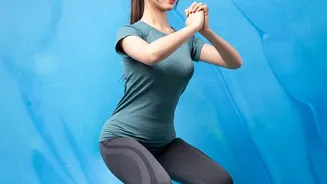
around your entire torso, including your lower back, hips, and pelvis. Think of it as your body's central stabiliser. A strong core provides the stability needed for almost every move you make, whether you're lifting groceries, playing with your kids, or simply bending down to tie your shoes. Neglecting these foundational muscles can lead to poor posture, an increased risk of lower back pain, and reduced endurance during physical activity. The good news is that strengthening this crucial muscle group doesn't require any special gear, just your own body weight and a bit of floor space.
The Classic Forearm Plank
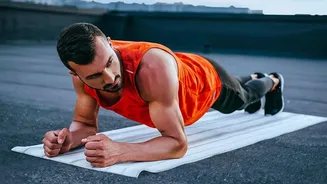
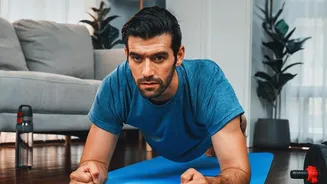
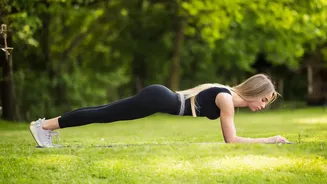
The plank is a fundamental core exercise for a reason: it engages multiple muscle groups simultaneously, including the deep transverse abdominis, which acts like a natural corset for your spine. To perform it correctly, start by lying on your stomach. Place your forearms on the floor with your elbows stacked directly beneath your shoulders. Lift your hips off the ground, resting your weight on your forearms and toes. Your body should form a straight, rigid line from your head to your heels. Avoid common mistakes like letting your hips sag or pushing them too high in the air. Engage your abdominals by pulling your belly button toward your spine, squeeze your glutes, and look at the floor just ahead of your hands to keep your neck in a neutral position. Beginners should aim to hold this position for 15 to 30 seconds, focusing on perfect form over duration.
The Dead Bug
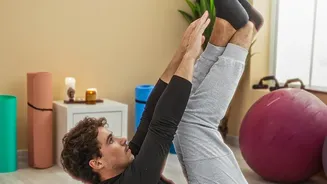
Don't let the unusual name fool you; the dead bug is a powerhouse for developing core stability and coordination without straining your back. Start by lying on your back with your arms extended toward the ceiling, directly over your shoulders. Bend your hips and knees to a 90-degree angle, as if you're sitting in a chair. Press your lower back gently into the floor to engage your abs. On an exhale, slowly lower your right arm and left leg toward the floor simultaneously. Go as low as you can without letting your lower back arch. Inhale to return to the starting position with control. Then, repeat on the other side, lowering your left arm and right leg. This alternating movement challenges your core to resist extension and rotation, building functional strength.
The Bird-Dog
The bird-dog is another excellent exercise for improving stability across your core, hips, and back. Begin on all fours, with your hands directly under your shoulders and your knees under your hips. Keep your back flat and your gaze toward the floor. Engage your core to keep your torso still, then slowly extend your right arm straight forward and your left leg straight back at the same time. Imagine balancing a glass of water on your lower back. Hold the extended position for a moment, focusing on keeping your hips level and square to the ground. Slowly return to the starting position and repeat with the opposite arm and leg. This movement trains the muscles that support your spine, making it a great addition to any routine aimed at preventing back pain.
Glute Bridge
While often seen as a lower-body exercise, the glute bridge is fantastic for activating your entire posterior chain, including your glutes, hamstrings, and the stabilizing muscles of your lower back and core. Lie on your back with your knees bent, feet flat on the floor about hip-width apart, and your arms resting by your sides. Engage your core and glutes, then lift your hips off the floor until your body forms a straight line from your shoulders to your knees. Avoid arching your back at the top of the movement. Hold for a second, squeezing your glutes, before slowly lowering your hips back to the starting position. This exercise helps strengthen the connection between your lower body and your core.
Bicycle Crunch
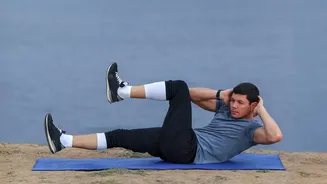
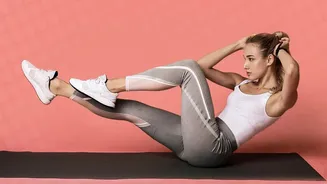
To target your obliques (the muscles on the sides of your abdomen) and the rectus abdominis, the bicycle crunch is a dynamic and effective choice. Lie on your back with your hands gently supporting your head and your knees bent. Lift your head, shoulders, and feet off the floor. Now, begin a 'pedalling' motion with your legs. As you bring your right knee toward your chest, twist your torso to bring your left elbow toward it. Then, straighten your right leg as you bring your left knee in and your right elbow to meet it. The key is to move with control, not speed. Focus on the twisting motion coming from your torso, not just from yanking on your neck. This will ensure you're working the intended muscles effectively and safely.