






A Discovery in the Deep Dark
Using the unprecedented power of the James Webb Space Telescope (JWST), astronomers have confirmed the presence of methane in the atmosphere of distant exoplanets. While methane has been seen before, finding it on a specific class of planet known as a 'Warm
Neptune' has sent ripples through the scientific community. This isn't the discovery of life itself, but the detection of a gas that is, on our own planet, overwhelmingly produced by living things. This finding forces scientists to ask a tantalizing question: what is making methane on a world so different from our own?
Meet the 'Warm Neptunes'
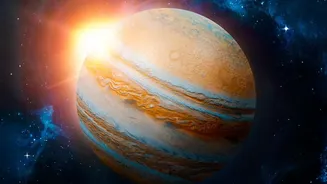
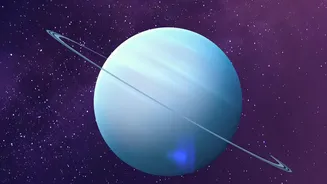
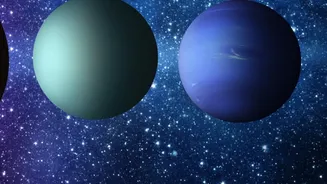
So, what exactly is a 'Warm Neptune'? These are planets similar in size to our own Neptune or Uranus, but they orbit much closer to their stars, resulting in warmer temperatures. They are not small, rocky planets like Earth, nor are they scorching gas giants like 'Hot Jupiters'. Instead, they occupy a middle ground. Typically, they are thought to have thick hydrogen and helium atmospheres over a core of rock and ice, sometimes with a deep mantle of hot, compressed water, ammonia, and methane. Until recently, they weren't considered prime candidates in the search for life, largely because they lack a solid surface and have atmospheres that seem inhospitable.
The Allure of Methane
On Earth, the vast majority of methane in the atmosphere is a byproduct of life. From microbes in wetlands to the digestive systems of animals, biological processes churn it out in enormous quantities. Methane is also unstable in an atmosphere; sunlight and chemical reactions break it down, so for it to be present in large amounts, something has to be constantly replenishing it. This is why finding an abundance of methane on another world is so exciting. It could be a 'biosignature'—a potential sign of biological activity. The James Webb Space Telescope is particularly good at detecting methane, making it one of the first potential signs of life astronomers might find.
A Cosmic Case for Caution
This is the point where the 'conversation' part of the headline becomes critical. Scientists are proceeding with extreme caution because life is not the only explanation for methane. Non-biological, or abiotic, processes can also produce it. Volcanoes, reactions in deep-sea vents, and even asteroid or comet impacts can all release methane. However, many scientists argue that these abiotic sources would struggle to produce the sheer volume of methane needed to be detectable in a planet's atmosphere from light-years away. Furthermore, non-biological processes often produce other gases, like carbon monoxide, alongside methane. The absence of significant carbon monoxide could strengthen the case for a biological origin.
Beyond a Single Molecule
No single discovery will ever be the definitive proof of alien life. Instead, scientists are looking for a collection of evidence. The ideal scenario would be to find a planet with methane, carbon dioxide, and water, but with very little carbon monoxide. This specific chemical cocktail is hard to explain with geology alone but is very consistent with the presence of a biosphere like the one on early Earth. The recent discoveries on Warm Neptunes are not on rocky, Earth-like planets, which makes the interpretation trickier. A gas giant like WASP-80 b is not considered habitable in the traditional sense, but studying its atmospheric methane helps scientists refine their models for all types of planets. These findings help them better understand the chemistry of alien atmospheres, which will be crucial when they do find methane on a potentially rocky, more Earth-like world.