



What is El Niño?
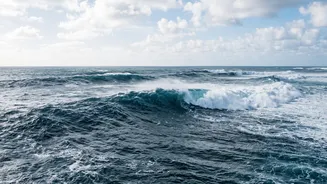
El Niño, which means 'the child' in Spanish, is a naturally occurring climate pattern. It is the warm phase of the El Niño-Southern Oscillation (ENSO), a recurring cycle of ocean warming and cooling in the tropical Pacific. During an El Niño event, the normal
east-to-west trade winds over the ocean weaken or even reverse. This change allows a massive pool of warm surface water, typically pushed towards Asia, to slosh back towards the central and eastern Pacific Ocean, along the coast of South America. This significant shift in ocean heat disrupts atmospheric circulation patterns across the globe, leading to widespread changes in weather, from droughts in some regions to heavy floods in others.
The Ocean's Warming Signal
Scientists monitor a key region of the equatorial Pacific, known as the Niño 3.4 region, to track this phenomenon. When sea surface temperatures (SSTs) there rise at least 0.5°C above the long-term average for a sustained period, and the atmosphere responds to this warming, an El Niño event is declared. The higher the temperature anomaly, the stronger the El Niño. Recent data shows that these temperatures are not just slightly elevated; they are exceptionally high. As of November 2026, weekly temperature anomalies in this critical region have remained above +3.0°C for several consecutive weeks, a clear sign of a very strong and persistent event.
The Outlook for 2026-2027
Global climate agencies like the World Meteorological Organization (WMO) and the National Oceanic and Atmospheric Administration (NOAA) have confirmed that a strong El Niño is not just likely, but already underway and strengthening. The latest forecasts from mid-November 2026 indicate a greater than 79% chance that a 'strong-to-very strong' El Niño will persist through the Northern Hemisphere's winter into March 2027. In fact, there is a significant chance that the current event could become one of the most powerful on record since 1950, with temperature anomalies potentially rivaling or even exceeding the historic events of 1997-98 and 2015-16. The event is expected to reach its peak intensity around December 2026 or January 2027 before gradually weakening in the spring.
Potential Impacts for India
For India, El Niño is a critical factor for its climate, particularly the southwest monsoon, which is vital for the nation's agriculture-dependent economy. Historically, strong El Niño events have been linked with weaker monsoon rainfall and drought conditions in parts of India, as the altered weather patterns can disrupt the flow of moisture. This can lead to lower crop yields for staples like rice, pulses, and oilseeds, potentially affecting food availability and driving up prices. A deficient monsoon also puts a strain on water resources for drinking and power generation. However, the connection is not always direct. Other climate factors, such as the Indian Ocean Dipole (IOD), can either counteract or worsen El Niño's influence. While a poor monsoon is a significant risk, it is not a guaranteed outcome, and the India Meteorological Department (IMD) will continue to monitor all factors closely before issuing its long-range forecasts for 2027.